Radxa ROCK 5C
No live price yetAffiliate link. As an Amazon Associate I earn from qualifying purchases. Details
Radxa ROCK 5C review
Researched, not hands-on tested.How we review ›
by SudoPicks Research · editor Paul HR · published 29 Oct 2026 · updated 29 Oct 2026
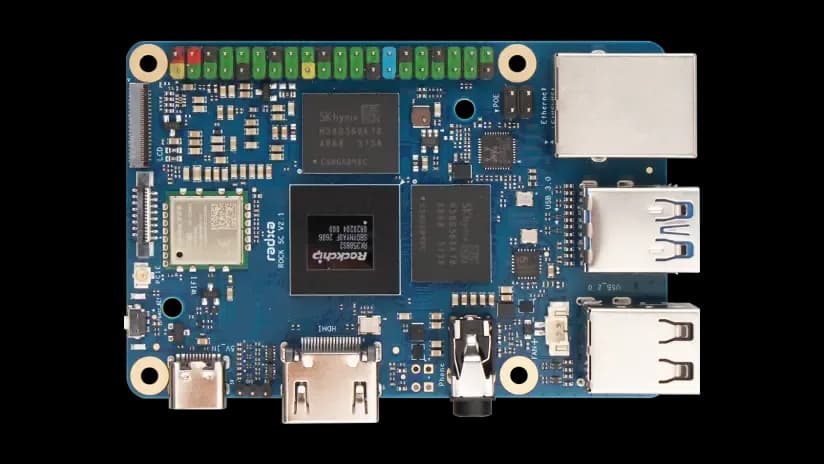
The ROCK 5C is for homelabbers and developers who want a lot of CPU and RAM in a small board. It suits people who are happy to follow Radxa's own Debian and Android images or the third-party systems listed for it.
joint 7th of 15 single-board computers we've reviewedAffiliate link. As an Amazon Associate I earn from qualifying purchases. Details
New to single-board computers? What they are and what to look for
A single-board computer, like a Raspberry Pi, is a tiny, cheap computer on one circuit board. People use them to learn coding, build gadgets, and run small home servers.
Do you need a single-board computer? Great for tinkering, learning Linux or electronics, or running things like a home-automation hub or ad blocker. Not a replacement for a normal PC.
What to look for
- A power supply, case and microSD card: they're often sold separately
- 4GB or more of memory for anything beyond simple projects
- How big the community is: more guides and help for popular boards
Unsure about a word? Jargon explained
How the 6.5 adds up
Our single-board computers rubric- Software support30% of score
- Performance25% of score
- Storage15% of score
- I/O and networking15% of score
- Value15% of score
Against the 15 single-board computers we've reviewed
bar = the range of all 15 · dot = this one · better →
- Overall score 6.5/10joint 7th of 15
Power use and running costs
Running 24/7 at idle, at 26.32p per kWh (the Ofgem price cap).
- Electricity per year
- £3.69
- 14 kWh
- 3 years, all in
- -
- no price yet
- Against the others
- 6th of 13
- 1st = lowest idle power
- Raspberry Pi Zero 2 W0.5 W£1.15
- Arduino UNO Q 4GB0.5 W£1.15
- Banana Pi BPI-M2 ZERO0.5 W£1.15
- Raspberry Pi 3 Model A+1.1 W£2.54
- Raspberry Pi 3 Model B1.4 W£3.23
- Radxa ROCK 5C (this)1.6 W£3.69
- Khadas VIM31.8 W£4.15
- BeagleBoard BeagleBone Black2.7 W£6.23
- Orange Pi 5 Plus2.8 W£6.46
- Raspberry Pi 4 Model B 1GB2.85 W£6.57
- Raspberry Pi 5 4GB3 W£6.92
- Raspberry Pi 4003 W£6.92
- IceWhale ZimaBoard 28.2 W£18.91
- Raspberry Pi Zero 2 W£17.86
- Banana Pi BPI-M2 ZERO£27.39
- Raspberry Pi 3 Model A+£30.47
- Raspberry Pi 3 Model B£42.68
- Arduino UNO Q 4GB£62.77
- Raspberry Pi 4 Model B 1GB£64.01
- Raspberry Pi 400£78.35
- BeagleBoard BeagleBone Black£92.68
- Raspberry Pi 5 4GB£126.35
- IceWhale ZimaBoard 2£345.61
Today's best price, or the typical price when researched. Drives and accessories not included.
Not shown, as no idle figure is published: Raspberry Pi Zero WH, Banana Pi BPI-M2 Berry.
Support and features
| Software updates | Until September 2032. Radxa's product brief revision 1.4 guarantees availability until at least September 2032, a minimum rather than a formal end-of-life notice; an earlier copy says September 2033. source |
|---|
- PoE
- Gigabit Ethernet
- 4GB+ memory
Featured in: Best single-board computers for Home Assistant
Measured by owners
No owner readings yet. If you own one and have a smart plug or power meter, a reading takes a minute and helps everyone else.
Security and compatibility
| Latest firmware or software | August 2025no update for over a year source |
|---|---|
| Known security issues | None found in public advisories. That's a good sign, not a guarantee. |
| Open firmware | Supported by OpenWrt |
| Update record | No CVE or Radxa advisory naming the ROCK 5C was found, though the searches were not exhaustive, and the latest release date could not be confirmed. |
| Linux | Works on Linux. Armbian lists Platinum support with 13 images, including recent Debian releases, though forum threads report a missing USB-3 port on one 6.12.58 image and a WiFi driver extension that breaks vendor kernel boot. source |
Pros and cons
+ pros
- Eight-core RK3588S2 with 6 TOPS NPU
- RAM options from 4GB up to 32GB
- Raspberry Pi-style 40-pin header
− cons
- No native M.2 slot; microSD bottlenecks storage
- No power supply in the box
- PCIe drive stays powered when board is off
Price history
Price history appears here once we have tracked this product for a few days.
The full review
Where it fits
The ROCK 5C is built around the Rockchip RK3588S2. It has four Cortex-A76 cores at up to 2.4GHz and four Cortex-A55 cores at up to 1.8GHz, with an Arm Mali-G610MC4 GPU and a 6 TOPS NPU. That suits multi-threaded work such as builds, containers and local services. Owners praise its multi-core performance and value.
RAM comes in 4GB, 8GB, 16GB and 32GB versions. The V1.1 board uses LPDDR4X and the V2.1 board uses LPDDR5, so check which revision you are buying. The 16GB and 32GB tiers give container-heavy setups plenty of headroom.
Software5/10
Radxa lists its own Debian and Android images, along with third-party systems. Notebookcheck says Android is only on the 5C. That gives you official images from the manufacturer as a starting point, with third-party systems as alternatives.
Because support comes through Radxa's images and those third-party systems, check that the image you want covers your workload before you commit to a specific project.
Storage5/10
This is the board's main limitation. It has one eMMC connector and one microSD slot, with no SPI flash and no native M.2 slot. The one route to fast storage is a 1-lane PCIe 2.1 connection through an FPC connector.
Owners complain that storage is bottlenecked by microSD. If you stay on a card, that matches the complaint. If you use the PCIe connector for a drive, owners report that the drive stays powered and heats up when the board is off. That matters for anyone planning an always-plugged-in setup.
I/O and networking6/10
Networking is Gigabit Ethernet, with PoE possible through an optional HAT. Wireless is WiFi 6 and Bluetooth 5.4, with an external antenna connector. There is no 2.5GbE port, so wired throughput tops out at gigabit.
The 40-pin header follows the Raspberry Pi-style layout, with 3.3V logic and up to 27 GPIO. That helps if you already have wiring built around that pinout. Video outputs are one HDMI 2.1 port up to 8K and one MIPI DSI up to 2K.
Power
The board runs from 5V over USB Type-C. Radxa recommends at least 10W, and 25W with full USB and PCIe load. No power supply is included. You need to buy a USB-C PD adapter of 30W or more separately, and owners list this as a complaint. Budget for that extra purchase.
Who it suits
With eight cores, a 6 TOPS NPU and up to 32GB of RAM, the ROCK 5C suits compute-heavy hobby projects, container hosts and edge experiments. With microSD, eMMC or an FPC-connected PCIe drive as the only storage options, it suits you better if you are comfortable adapting storage than if you want a plug-in NVMe drive. Owner feedback points the same way: strong value and multi-core performance, held back by storage, the missing power supply and PCIe power behaviour.
What owners report
Recurring themes from public owner feedback, summarised in our own words.
- Owners praise the value and multi-core performance.
- Owners say microSD storage is a bottleneck.
- Owners dislike that no power supply is included.
- Owners report a PCIe drive stays powered and heats up while the board is off.
Who should skip it
- Buyers who want a native M.2 NVMe slot on the board
- Buyers who want a power supply included in the box
Full specifications
| Processor (SoC) | Rockchip RK3588S2 |
|---|---|
| Memory | 4GB, 8GB, 16GB or 32GB; V1.1 uses LPDDR4X, V2.1 uses LPDDR5 |
| Storage options | 1x eMMC connector, 1x microSD card slot, no SPI flash; no native M.2 slot; PCIe 2.1 1-lane via FPC connector |
| Networking | Gigabit Ethernet (PoE via optional HAT), WiFi 6, BT 5.4 with external antenna connector |
| GPIO | 40-pin header, Raspberry Pi-style layout, 3.3V logic, up to 27 GPIO |
| Video outputs | 1x HDMI 2.1 up to 8K, 1x MIPI DSI up to 2K |
| Power input | 5V via USB Type-C; at least 10W recommended, 25W with full USB and PCIe load |
Sources
- Radxa ROCK 5C product page
- Radxa ROCK 5C documentation introduction
- Radxa ROCK 5C hardware interface
- Radxa ROCK 5C product brief
- Radxa ROCK 5C official announcement
- Radxa forum launch announcement
- sbc.compare Radxa ROCK 5C
- Geerling sbc-reviews issue 41
- Eneba Radxa ROCK 5C review
- Arace Radxa ROCK 5C
- c0m4r gist on ROCK 5C Lite
- Notebookcheck Radxa ROCK 5C and 5C Lite
- RS Components ROCK SBC listing
- RS Components ROCK SBC shop category