Raspberry Pi 3 Model B
Price unavailable right nowAffiliate link. As an Amazon Associate I earn from qualifying purchases. Details
Raspberry Pi 3 Model B review
Researched, not hands-on tested.How we review ›
by SudoPicks Research · published 24 Oct 2026 · updated 24 Oct 2026
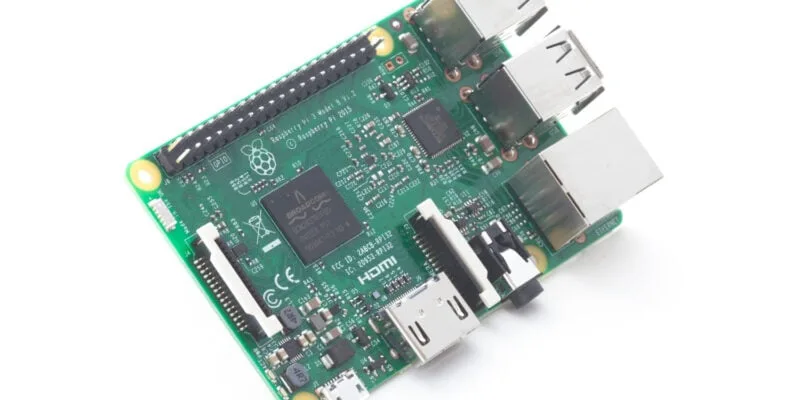
The Raspberry Pi 3 Model B suits people who want a small board for GPIO projects, simple services or learning. It fits builders who need a 40-pin header with camera and display ports.
3rd of 6 single-board computers we've reviewedAffiliate link. As an Amazon Associate I earn from qualifying purchases. Details
How the 6.4 adds up
Our single-board computers rubric- Software support30% of score
- Performance25% of score
- Storage15% of score
- I/O and networking15% of score
- Value15% of score
Against the 6 single-board computers we've reviewed
bar = the range of all 6 · dot = this one · better →
- Overall score 6.4/103rd of 6
- Price £332nd cheapest
- Value for money 19.4 per £1002nd of 6
Power use and running costs
Running 24/7 at idle, at 26.32p per kWh (the Ofgem price cap).
- Electricity per year
- £3.23
- 12 kWh
- 3 years, all in
- £42.68
- £33.00 to buy + £9.68 to run
- Against the others
- 2nd of 5
- 1st = lowest idle power
- Arduino UNO Q 4GB0.5 W£1.15
- Raspberry Pi 3 Model B (this)1.4 W£3.23
- Raspberry Pi 4 Model B 1GB2.85 W£6.57
- Raspberry Pi 5 4GB3 W£6.92
- ZimaBoard 28.2 W£18.91
- Raspberry Pi 3 Model B (this)£42.68
- Arduino UNO Q 4GB£62.77
- Raspberry Pi 4 Model B 1GB£64.01
- Raspberry Pi 5 4GB£126.35
- ZimaBoard 2£345.61
Today's best price, or the typical price when researched. Drives and accessories not included.
Not shown, as no idle figure is published: Raspberry Pi Zero WH.
Running costs and support
| Software updates | No announced end of software or security updates; January 2028 is a production date, not a support end. source |
|---|
Pros and cons
+ pros
- 40-pin GPIO header plus CSI camera and DSI display ports
- Built-in wireless LAN and Bluetooth
- Production promised until at least January 2028
− cons
- Ethernet is 10/100 only, not gigabit
- No USB 3; four USB 2.0 ports
- microSD only, with no M.2 or NVMe support published
Price history
Price history appears here once we have tracked this product for a few days.
The full review
Where it fits
The Raspberry Pi 3 Model B came out in February 2016 and replaced the Raspberry Pi 2 Model B. It uses a Broadcom BCM2837 with four 64-bit ARM Cortex-A53 cores at 1.2 GHz, and it has 1GB of RAM. That is the only memory configuration in the research, so there is no larger tier to step up to.
Its strengths are the connectors for hardware projects and its place in the Raspberry Pi range. Its limits are in networking and storage. If you know which of those matter to you, the decision is straightforward.
Processor and memory
Four cores at 1.2 GHz give the board enough to run a handful of light tasks side by side. The research does not list benchmark figures, so any claim about speed beyond the core count and clock would be guesswork. What the specifications do show is a fixed 1GB of RAM. With that ceiling, the board suits a few small services, a single-purpose appliance or a teaching machine better than several memory-hungry workloads running together.
The 64-bit Cortex-A53 design is noted in the specification. The research does not cover which operating systems use that, so check your chosen OS before you buy.
Storage4/10
Storage is a microSD slot, used for both the operating system and your data. The research states that no M.2 or NVMe support is published. There is no other storage interface in the specification, so everything lives on the card.
That shapes how you would use it. A project that logs a lot of data or needs a separate data drive has no obvious home for it on this board's listed hardware. The board has four USB 2.0 ports, but the research does not say how they work as storage.
Networking and ports5/10
Wired networking is 10/100 Ethernet, not gigabit. The research is explicit on this point. Wireless LAN and Bluetooth are built in, so the board can join a wireless network without an adapter.
There are four USB 2.0 ports and no USB 3. With 100Mb wired networking and USB 2.0 only, the board is a poor choice for moving large files around a network or for fast external disks. It is better matched to small traffic: sensor data, control signals, lightweight web pages or remote shell access.
GPIO, video and expansion
This is where the board does most of its work. It has a 40-pin extended GPIO header, a CSI camera port and a DSI display port. Video output is a full-size HDMI port, plus a 4-pole connector that carries stereo audio and composite video.
The header is the main reason to pick it for electronics, home automation or a camera project. The camera and display ports let you attach compatible modules without going through USB. The research does not list specific modules, so check compatibility for the exact camera or screen you plan to use.
Power
Power comes in through Micro USB, and the specification lists up to a 2.5 A switched supply. Several sources in the research cover power consumption, but the figures are not reproduced here, so there is no draw number to quote. Plan for a supply that meets the 2.5 A rating and check the current needs of anything you attach.
Lifecycle and support10/10
Raspberry Pi Ltd says the Model B will stay in production until at least January 2028. That is a production commitment. It is not a software support end date, and the research does not give one.
The research does not describe the software ecosystem in detail, so this review does not list particular operating system releases or kernel versions. Check the manufacturer's current software pages before you commit.
Who it suits
Choose this board if the 40-pin header, camera and display ports and built-in wireless matter more to you than raw throughput. It suits a learning project, a small controller or a light always-on service. Look elsewhere if you need gigabit Ethernet, USB 3, more than 1GB of RAM or storage beyond a microSD card.
Who should skip it
- Anyone who needs gigabit Ethernet or USB 3 for fast file transfers
- Buyers who want NVMe or M.2 storage rather than a microSD card
- People who need more than 1GB of RAM for several services or VMs
Full specifications
| Processor (SoC) | Broadcom BCM2837, quad-core 64-bit ARM Cortex-A53 at 1.2 GHz |
|---|---|
| Memory | 1GB RAM |
| Storage options | microSD slot only, for OS and data |
| Networking | 100Base Ethernet; wireless LAN and Bluetooth |
| GPIO | 40-pin extended GPIO header |
| Video outputs | Full-size HDMI, 4-pole stereo and composite video port, CSI camera port, DSI display port |
| Power input | Micro USB, up to 2.5 A switched supply |
Sources
- Raspberry Pi 3 Model B product page
- Raspberry Pi 4 Model B datasheet
- Raspberry Pi 3 specs and benchmarks (Raspberry Pi Official Magazine)
- Raspberry Pi product information portal, Model 3B
- endoflife.date Raspberry Pi
- EOSL Raspberry Pi
- Raspberry Pi prices and lifecycle
- Raspberry Pi power consumption benchmarks
- Raspberry Pi 3 power consumption explained
- Raspberry Pi power consumption
- Raspberry Pi 3 power requirements
- Raspberry Pi forum thread t=374010
- Andlight Raspberry Pi power draw article
- eBay DE listing (GTIN only)