Raspberry Pi 3 Model A+
~£22.86typical UK price when we researched itAffiliate link. As an Amazon Associate I earn from qualifying purchases. Details
Raspberry Pi 3 Model A+ review
Researched, not hands-on tested.How we review ›
by SudoPicks Research · editor Paul HR · published 29 Oct 2026 · updated 29 Oct 2026
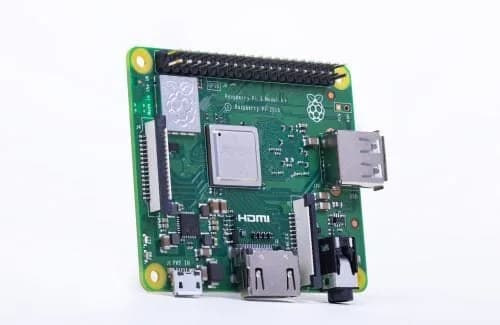
The Raspberry Pi 3 Model A+ is for people who want a small, low-power board for a single, light job. It suits wireless projects that use the 40-pin GPIO header, a display or a camera.
joint 7th of 15 single-board computers we've reviewedAffiliate link. As an Amazon Associate I earn from qualifying purchases. Details
New to single-board computers? What they are and what to look for
A single-board computer, like a Raspberry Pi, is a tiny, cheap computer on one circuit board. People use them to learn coding, build gadgets, and run small home servers.
Do you need a single-board computer? Great for tinkering, learning Linux or electronics, or running things like a home-automation hub or ad blocker. Not a replacement for a normal PC.
What to look for
- A power supply, case and microSD card: they're often sold separately
- 4GB or more of memory for anything beyond simple projects
- How big the community is: more guides and help for popular boards
Unsure about a word? Jargon explained
How the 6.5 adds up
Our single-board computers rubric- Software support30% of score
- Performance25% of score
- Storage15% of score
- I/O and networking15% of score
- Value15% of score
Against the 15 single-board computers we've reviewed
bar = the range of all 15 · dot = this one · better →
- Overall score 6.5/10joint 7th of 15
- Price £22.863rd cheapest
- Value for money Better value than most3rd best of 12
Power use and running costs
Running 24/7 at idle, at 26.32p per kWh (the Ofgem price cap).
- Electricity per year
- £2.54
- 10 kWh
- 3 years, all in
- £30.47
- £22.86 to buy + £7.61 to run
- Against the others
- 4th of 13
- 1st = lowest idle power
- Raspberry Pi Zero 2 W0.5 W£1.15
- Arduino UNO Q 4GB0.5 W£1.15
- Banana Pi BPI-M2 ZERO0.5 W£1.15
- Raspberry Pi 3 Model A+ (this)1.1 W£2.54
- Raspberry Pi 3 Model B1.4 W£3.23
- Radxa ROCK 5C1.6 W£3.69
- Khadas VIM31.8 W£4.15
- BeagleBoard BeagleBone Black2.7 W£6.23
- Orange Pi 5 Plus2.8 W£6.46
- Raspberry Pi 4 Model B 1GB2.85 W£6.57
- Raspberry Pi 5 4GB3 W£6.92
- Raspberry Pi 4003 W£6.92
- IceWhale ZimaBoard 28.2 W£18.91
- Raspberry Pi Zero 2 W£17.86
- Banana Pi BPI-M2 ZERO£27.39
- Raspberry Pi 3 Model A+ (this)£30.47
- Raspberry Pi 3 Model B£42.68
- Arduino UNO Q 4GB£62.77
- Raspberry Pi 4 Model B 1GB£64.01
- Raspberry Pi 400£78.35
- BeagleBoard BeagleBone Black£92.68
- Raspberry Pi 5 4GB£126.35
- IceWhale ZimaBoard 2£345.61
Today's best price, or the typical price when researched. Drives and accessories not included.
Not shown, as no idle figure is published: Raspberry Pi Zero WH, Banana Pi BPI-M2 Berry.
Support and features
| Software updates | No software support end date found; production continues until at least January 2030. source |
|---|
Measured by owners
No owner readings yet. If you own one and have a smart plug or power meter, a reading takes a minute and helps everyone else.
Security and compatibility
| Latest firmware or software | October 2026updated in the last year source |
|---|---|
| Known security issues | None found in public advisories. That's a good sign, not a guarantee. |
| Update record | No advisory found names the A+ or its firmware; the latest maker advisory found (CVE-2026-13199) affects Pi 5 boot firmware, and the release date conflicts with Wikipedia's 15 September 2026 entry. |
| Linux | Works on Linux. Raspberry Pi OS supports all Raspberry Pi models except Pico, and the 2026-06-18 release shipped Linux kernel 6.18.34 LTS; drivers and mainline kernel support were not checked. source |
Pros and cons
+ pros
- Compact board with low idle power draw
- Dual-band Wi-Fi and Bluetooth 4.2 built in
- Extended 40-pin GPIO header plus HDMI, DSI and CSI ports
− cons
- No Ethernet port; wireless networking only
- Single USB 2.0 port limits peripherals
- 512MB RAM and micro SD only
Price history
Price history appears here once we have tracked this product for a few days.
The full review
Where it fits
The Raspberry Pi 3 Model A+ from Raspberry Pi Ltd. launched on 15 November 2018. It uses the Broadcom BCM2837B0, a quad-core Cortex-A53 64-bit SoC running at 1.4 GHz, with 512MB of LPDDR2 SDRAM. Owners praise its compact size and low price. They also complain about limited I/O and modest performance for heavier apps. Those two themes define the board: it suits a fixed, light job and not a general-purpose machine.
Performance and memory5/10
Four 64-bit cores at 1.4 GHz give it a reasonable processor for small tasks. Memory is the tighter limit. The specification lists 512MB of LPDDR2 and nothing else. With that ceiling, and with owners reporting modest performance for heavier apps, it suits one lightweight service or a dedicated display or camera project better than several services running together.
Owners also praise its low idle power draw. That fits an always-on role where the board spends most of its time waiting. Power comes in at 5V via micro USB, and the manufacturer recommends a 2.5A supply. You can instead feed 5V in through the GPIO header.
Networking and ports5/10
This is where the A+ gives up the most. There is no Ethernet port. Networking is wireless only, with 2.4GHz and 5GHz 802.11b/g/n/ac and Bluetooth 4.2/BLE. Dual-band Wi-Fi is useful, but a box that must sit on a wired network is not possible with this board. That is the basis for the owner complaint about the missing wired connection.
There is a single USB 2.0 port. Keyboard, storage and any other USB device all compete for that one socket. Owners cite limited I/O as a complaint, and the port count is the reason.
Video and expansion are better served. The board has one full-size HDMI port, a DSI display port, a CSI camera port and a 4-pole stereo/composite port. It also has an extended 40-pin GPIO header. With the display and camera ports alongside it, that connector set points towards display or camera projects.
Storage4/10
Storage is a micro SD card slot, used for both the operating system and data. The specification shows no onboard eMMC and no M.2 or NVMe connector. Everything lives on one card, and with a single USB 2.0 port there is little room to add anything else. It works for a small appliance-style build. It is a weak base for a project that needs a lot of storage or storage that is separate from the boot media.
Longevity
The product brief states that production continues until at least January 2030. That is a production commitment and not a software support date, so it says how long the hardware will be made rather than how long updates will arrive.
Bottom line
The Model A+ is a narrow tool. Wireless-only networking, one USB 2.0 port, 512MB of RAM and micro SD storage all point towards small, single-purpose builds. Its low idle power draw, compact size and full set of display, camera and GPIO connectors suit that kind of work. If your plan depends on wired Ethernet, several USB devices or heavier applications, the specification and the owner complaints both point away from this board.
What owners report
Recurring themes from public owner feedback, summarised in our own words.
- Owners like the compact size and low price.
- The lack of wired Ethernet and the limited I/O draw complaints.
- Performance is described as modest once apps get heavier.
- Low idle power draw earns praise.
Who should skip it
- Anyone who needs a wired Ethernet connection for a server or network appliance
- Buyers who plan to run heavier apps or several services at once
- People who need more than one USB port or storage beyond a micro SD card
Full specifications
| Processor (SoC) | Broadcom BCM2837B0, quad-core Cortex-A53 64-bit SoC at 1.4 GHz |
|---|---|
| Memory | 512MB LPDDR2 SDRAM |
| Storage options | Micro SD card slot for OS and data; no onboard eMMC or M.2/NVMe connector found in sources |
| Networking | 2.4GHz and 5GHz 802.11b/g/n/ac wireless LAN, Bluetooth 4.2/BLE; no Ethernet port |
| GPIO | Extended 40-pin GPIO header |
| Video outputs | One full-size HDMI port, DSI display port, CSI camera port, 4-pole stereo/composite port |
| Power input | 5V/2.5A DC via micro USB, or 5V DC via GPIO header |
Sources
- Raspberry Pi 3 Model A+ product page
- Raspberry Pi 3 Model A+ product brief
- Raspberry Pi 3 Model A launch post
- Raspberry Pi documentation: single-board computers
- Raspberry Pi documentation
- Expert Reviews: Raspberry Pi 3 Model A+ review
- Notebookcheck: Raspberry Pi 3 Model A review
- element14 road test: Raspberry Pi 3 Model A+
- Raspberry Pi forum thread
- PriceSpy listing
- Rapid Online listing
- The Pi Hut product page