Raspberry Pi Zero 2 W
~£14.40typical UK price when we researched itAffiliate link. As an Amazon Associate I earn from qualifying purchases. Details
Raspberry Pi Zero 2 W review
Researched, not hands-on tested.How we review ›
by SudoPicks Research · editor Paul HR · published 27 Oct 2026 · updated 27 Oct 2026
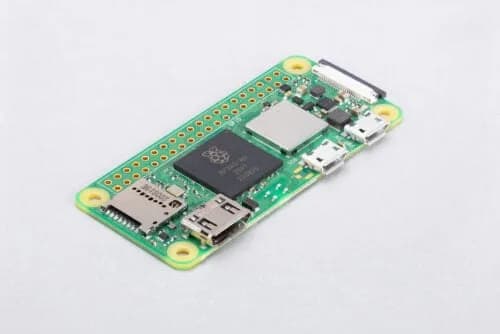
The Raspberry Pi Zero 2 W is for people who need a wireless quad-core Arm board for headless projects. It suits those replacing an original Pi Zero or building embedded and IoT jobs that need a 40-pin footprint and Bluetooth.
4th of 8 single-board computers we've reviewedAffiliate link. As an Amazon Associate I earn from qualifying purchases. Details
New to single-board computers? What they are and what to look for
A single-board computer, like a Raspberry Pi, is a tiny, cheap computer on one circuit board. People use them to learn coding, build gadgets, and run small home servers.
Do you need a single-board computer? Great for tinkering, learning Linux or electronics, or running things like a home-automation hub or ad blocker. Not a replacement for a normal PC.
What to look for
- A power supply, case and microSD card: they're often sold separately
- 4GB or more of memory for anything beyond simple projects
- How big the community is: more guides and help for popular boards
Unsure about a word? Jargon explained
How the 6.9 adds up
Our single-board computers rubric- Software support30% of score
- Performance25% of score
- Storage15% of score
- I/O and networking15% of score
- Value15% of score
Against the 8 single-board computers we've reviewed
bar = the range of all 8 · dot = this one · better →
- Overall score 6.9/104th of 8
- Price £14.40cheapest
- Value for money Best value herebest of 8
Power use and running costs
Running 24/7 at idle, at 26.32p per kWh (the Ofgem price cap).
- Electricity per year
- £1.15
- 4 kWh
- 3 years, all in
- £17.86
- £14.40 to buy + £3.46 to run
- Against the others
- 1st of 7
- 1st = lowest idle power
- Raspberry Pi Zero 2 W (this)0.5 W£1.15
- Arduino UNO Q 4GB0.5 W£1.15
- Raspberry Pi 3 Model B1.4 W£3.23
- Raspberry Pi 4 Model B 1GB2.85 W£6.57
- Raspberry Pi 5 4GB3 W£6.92
- Raspberry Pi 4003 W£6.92
- IceWhale ZimaBoard 28.2 W£18.91
- Raspberry Pi Zero 2 W (this)£17.86
- Raspberry Pi 3 Model B£42.68
- Arduino UNO Q 4GB£62.77
- Raspberry Pi 4 Model B 1GB£64.01
- Raspberry Pi 400£78.35
- Raspberry Pi 5 4GB£126.35
- IceWhale ZimaBoard 2£345.61
Today's best price, or the typical price when researched. Drives and accessories not included.
Not shown, as no idle figure is published: Raspberry Pi Zero WH.
Support and features
| Software updates | No software or security update end date announced; production committed until at least January 2030. source |
|---|
Measured by owners
No owner readings yet. If you own one and have a smart plug or power meter, a reading takes a minute and helps everyone else.
Security and compatibility
| Latest firmware or software | October 2026updated in the last year source |
|---|---|
| Known security issues | None found in public advisories. That's a good sign, not a guarantee. |
| Update record | Heise reports a Raspberry Pi OS release dated 2026-10-06, and no advisory naming the Zero 2 W or its firmware was found, though the search was limited. |
| Linux | Partly works on Linux. Raspberry Pi OS supports the model with a 6.18 LTS kernel, but the Wi-Fi firmware is missing from linux-firmware, so distributions cannot easily ship it. source |
Pros and cons
+ pros
- Quad-core 1GHz CPU is a clear step up from the original Zero
- Drop-in replacement for the original Zero, easing migration
- Wi-Fi is competent and the onboard antenna is decent
− cons
- 512MB RAM hampers web browsing
- Runs hot under load and needs cooling
- No Ethernet, no 5GHz Wi-Fi, header pins unpopulated
Price history
Price history appears here once we have tracked this product for a few days.
The full review
Where it fits
The Raspberry Pi Zero 2 W is a board built around the Broadcom BCM2710A1, a quad-core 64-bit Arm Cortex-A53 running at 1GHz. It has 512MB of LPDDR2 memory. Raspberry Pi says it will keep the board in production until at least January 2030. That is a production commitment, not a software support end date, but it gives anyone planning a repeat build a stated availability window.
Performance and memory6/10
Owners describe the quad-core chip as a clear step up from the original Pi Zero. That matters if you are moving an existing project across.
The 512MB of RAM is the main limit. Owners report that it hampers web browsing. With that ceiling and a 1GHz CPU, the board suits headless jobs such as small services, sensors and scripts better than anything that leans on a browser.
Heat is the other recurring complaint. Owners say the chip runs hot under load and needs cooling. Those who overclocked report lock-ups, or needed active cooling to keep it stable. If you plan sustained load, plan for cooling too.
Storage4/10
Storage is a microSD card slot and nothing else. For a project that logs a lot of data or needs fast reads and writes, the card is the whole storage story here.
Connectivity and I/O
Wireless is 2.4GHz 802.11b/g/n Wi-Fi with Bluetooth 4.2 and BLE, using an onboard antenna. Owners call the Wi-Fi competent and the antenna decent.
There is no Ethernet and no 5GHz Wi-Fi. The single USB port is USB 2.0 OTG, with no USB 3. There is no Gigabit or faster Ethernet. Owners list the missing 5GHz band and wired networking as complaints, so a job that depends on either points to a different board.
Video comes from a Mini HDMI port, with composite video available through test points. Power goes in through Micro USB, with a supply rating of 5V DC at 2.5A.
The 40-pin I/O header footprint is HAT-compatible but unpopulated. Owners complain that you must solder the pins yourself. A pre-soldered variant, sold as "with headers", is offered alongside the bare board, so you can avoid the soldering by choosing it.
Cases and migration
The board fits existing Pi Zero cases, and owners praise it as a drop-in replacement for the original Zero. There is a catch. Some owners report that certain cases no longer fit because components have shifted. If you are reusing an enclosure, check it before you commit.
Availability
Launch supply was constrained by the chip shortage. Owners report that availability near the recommended price came only after the shortage eased.
Who it suits
With a quad-core CPU, built-in Wi-Fi and Bluetooth, and a HAT-compatible footprint, it suits small wireless projects and upgrades from the original Zero. With 512MB of RAM, a single USB 2.0 port and microSD-only storage, it is a weaker choice for browsers, file serving or anything that needs wired networking. Budget for cooling if you intend to push the CPU, and decide early whether you want the headers pre-soldered.
What owners report
Recurring themes from public owner feedback, summarised in our own words.
- Owners say the quad-core chip is a clear step up from the original Pi Zero.
- Owners like that it works as a drop-in replacement for the original Zero, though some cases no longer fit.
- Owners find the Wi-Fi competent but miss 5GHz Wi-Fi and Ethernet.
- Owners report the 512MB of RAM hampers browsing and that the chip runs hot under load, with overclocking causing lock-ups.
Who should skip it
- Buyers who need wired Ethernet or 5GHz Wi-Fi
- Anyone wanting a browser-based desktop with 512MB of RAM
- Buyers who need fast storage or USB 3 peripherals
Full specifications
| Processor (SoC) | Broadcom BCM2710A1, quad-core 64-bit Arm Cortex-A53 at 1GHz |
|---|---|
| Memory | 512MB LPDDR2 |
| Storage options | microSD card slot only |
| Networking | 2.4GHz 802.11b/g/n Wi-Fi, Bluetooth 4.2, BLE, onboard antenna; no Ethernet |
| GPIO | 40-pin HAT-compatible I/O header footprint, unpopulated |
| Video outputs | Mini HDMI port; composite video via test points |
| Power input | Micro USB, rated 5V DC 2.5A (supply rating) |
Sources
- Raspberry Pi Zero 2 W product page
- Raspberry Pi Zero 2 W product brief
- Raspberry Pi Zero 2 W launch post
- Raspberry Pi Official Magazine article on Zero 2 W
- Zero 2 W review (James A. Chambers)
- Zero 2 W review (Trusted Reviews)
- Zero 2 W hands-on (Hackster)
- Zero 2 W review (Tom's Hardware)
- Zero 2 W review (Magazin Mehatronika)
- Zero 2 W mini review (CNX Software)
- Everything about Zero 2 W (Picockpit)
- Zero 2 W temperature and power consumption (Andre Jacobs)
- Zero 2 W launch coverage (TechRadar)
- Raspberry Pi Zero 2 W forum thread