TP-Link LS108GP
Price unavailable right nowAffiliate link. As an Amazon Associate I earn from qualifying purchases. Details
TP-Link LS108GP review
Researched, not hands-on tested.How we review ›
by SudoPicks Research · published 24 Oct 2026 · updated 24 Oct 2026
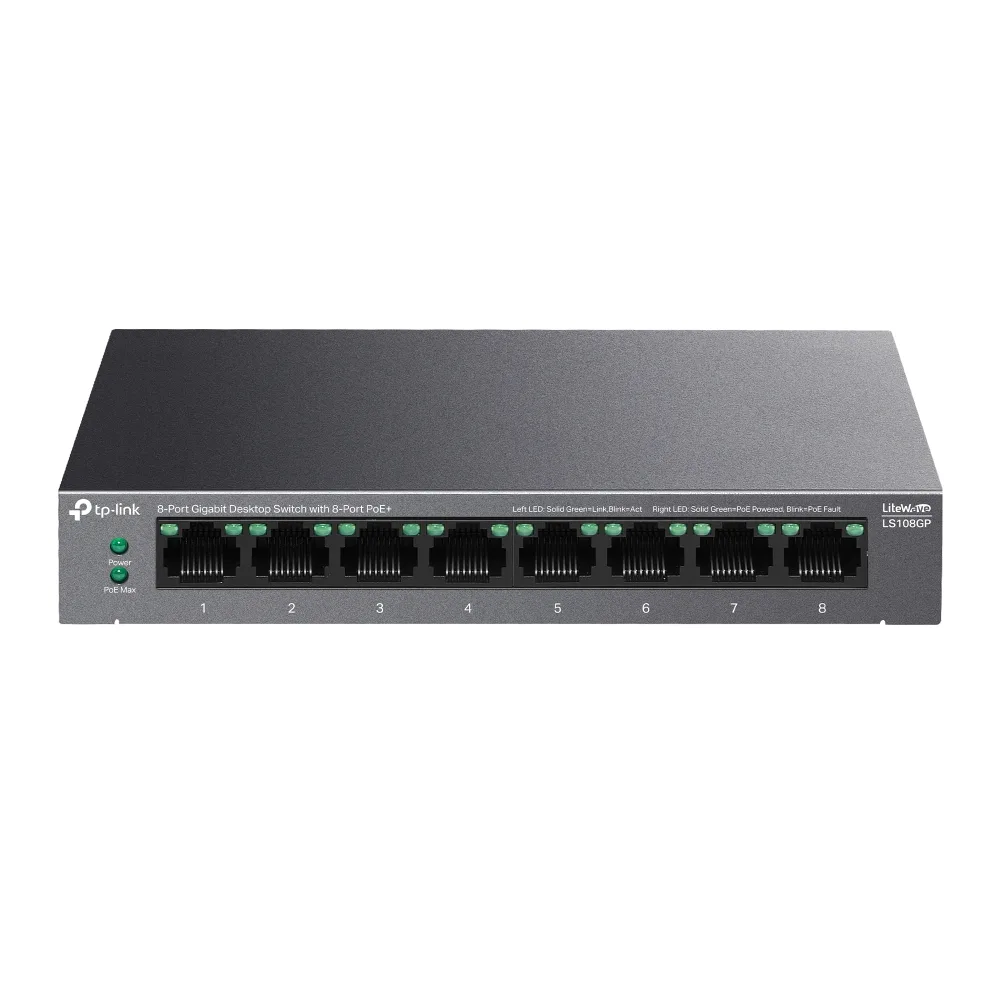
The LS108GP is for anyone who wants a small, silent, plug-and-play switch that also powers a few PoE devices such as access points or cameras. It suits desks, shelves and quiet rooms where a fan would be a nuisance.
joint 19th of 25 network switches we've reviewedAffiliate link. As an Amazon Associate I earn from qualifying purchases. Details
New to network switches? What they are and what to look for
A network switch adds more wired Ethernet sockets to your home network, like a power strip does for plugs. You connect it to your router with one cable.
Do you need a network switch? Useful if your router has run out of Ethernet ports, or you want wired connections for a TV, games console, desk or NAS.
What to look for
- Enough ports, with a couple spare
- Gigabit is fine for most homes; 2.5GbE helps with a fast NAS
- Fanless designs are silent; managed switches add features most homes don't need
Unsure about a word? Jargon explained
How the 6.0 adds up
Our network switches rubric- Port speeds30% of score
- Management20% of score
- Port count and uplinks15% of score
- PoE10% of score
- Noise and efficiency15% of score
- Firmware and support10% of score
Against the 25 network switches we've reviewed
bar = the range of all 25 · dot = this one · better →
- Overall score 6.0/10joint 19th of 25
- Price £39.999th cheapest
- Value for money 15.0 per £10010th of 25
Power use and running costs
Running 24/7 at idle, at 26.32p per kWh (the Ofgem price cap).
- Electricity per year
- £12.75
- 48 kWh
- 3 years, all in
- £78.24
- £39.99 to buy + £38.25 to run
- Against the others
- 11th of 16
- 1st = lowest idle power
- TP-Link TL-SG105S 5-Port Gigabit Desktop Switch1 W£2.31
- Ubiquiti UniFi Flex Mini 2.5G1.3 W£3.00
- NETGEAR GS108 8-Port Gigabit Unmanaged Switch1.5 W£3.46
- Ubiquiti UniFi Switch Flex Mini1.8 W£4.15
- NETGEAR GS308E2.5 W£5.76
- Ubiquiti UniFi Switch Lite 8 PoE3.7 W£8.53
- Zyxel XGS1210-123.95 W£9.11
- NETGEAR MS305 5-Port Multi-Gigabit4 W£9.22
- QNAP QSW-1105-5T4 W£9.22
- TP-Link Easy Smart Switch TL-SG105PE4.52 W£10.42
- TP-Link LS108GP (this)5.53 W£12.75
- MikroTik CRS305-1G-4S+IN10 W£23.06
- MikroTik CRS310-8G+2S+IN10.5 W£24.21
- MikroTik CRS326-24G-2S+RM12 W£27.67
- TP-Link TL-SX100812 W£27.67
- TP-Link TL-SG3210XHP-M217.24 W£39.75
Dashed bars use the maker's figure; solid bars were measured by reviewers or owners.
- TP-Link TL-SG105S 5-Port Gigabit Desktop Switch£20.91
- NETGEAR GS108 8-Port Gigabit Unmanaged Switch£35.37
- NETGEAR GS308E£42.26
- Ubiquiti UniFi Switch Flex Mini£45.45
- Ubiquiti UniFi Flex Mini 2.5G£61.98
- TP-Link Easy Smart Switch TL-SG105PE£71.25
- TP-Link LS108GP (this)£78.24
- QNAP QSW-1105-5T£120.81
- Ubiquiti UniFi Switch Lite 8 PoE£136.59
- Zyxel XGS1210-12£152.32
- NETGEAR MS305 5-Port Multi-Gigabit£155.44
- MikroTik CRS305-1G-4S+IN£190.36
- MikroTik CRS310-8G+2S+IN£258.20
- MikroTik CRS326-24G-2S+RM£258.32
- TP-Link TL-SX1008£402.00
- TP-Link TL-SG3210XHP-M2£459.25
Today's best price, or the typical price when researched. Drives and accessories not included.
Not shown, as no idle figure is published: Zyxel XMG1915-10E, Ubiquiti UniFi Flex 2.5G USW-Flex-2.5G-8, NETGEAR MS108EUP Ultra60 PoE++ Multi-Gig Plus Switch, TP-Link LS1005G 5-Port Gigabit Switch, TP-Link TL-SG108E, TP-Link TL-SG1005LP, NETGEAR GS305v3 5-Port Gigabit Unmanaged Switch, TP-Link TL-SG105-M2, TP-Link TL-SG108S.
Running costs and support
| Software updates | No end-of-support date announced for this model; general TP-Link policy sets end-of-maintenance about three years after end-of-sale source |
|---|
- PoE
- Fanless
Featured in: Best network switches with PoE · Best network switches that are silent
Security and compatibility
| Latest firmware or software | No release date found |
|---|---|
| Known security issues | None found in public advisories. That's a good sign, not a guarantee. |
| Update record | No firmware release date or changelog was found, and searches for CVEs naming the LS108GP returned nothing relevant, though this does not prove none exist. |
Pros and cons
+ pros
- Fanless metal case; owners praise silent operation
- All eight gigabit ports support 802.3af/at PoE
- Plug-and-play setup with IGMP snooping and QoS
− cons
- Shared 62 W PoE budget limits high-draw devices
- Unmanaged, with no VLAN support listed
- No SFP uplink or faster-than-gigabit ports listed
Price history
Price history appears here once we have tracked this product for a few days.
The full review
Where it fits
The TP-Link LS108GP is an eight-port gigabit switch with PoE on every port. Ports 1 to 8 all support 802.3af/at, so any of them can power a compatible device. It is unmanaged and plug-and-play, and TP-Link lists no VLAN support.
That makes it a simple add-on for a small network. Plug in an access point, a camera or a VoIP handset, and the switch supplies data and power over the same cable. It does not ask for configuration, and the research shows no web interface or controller.
Port speeds and switchingPort speeds 6/10Port count and uplinks 5/10
All eight RJ45 ports run at 10/100/1000 Mbps with auto-negotiation and auto MDI/MDIX. There is nothing faster listed and no SFP slot. If you want to move large files between machines at more than gigabit speed, this switch won't do it.
The switching capacity is 16 Gbps, with a forwarding rate of 11.9 Mpps. The MAC table holds 4K entries, and jumbo frames up to 16 KB are supported. The capacity figure matches eight gigabit ports running in both directions. The 4K MAC table suits a small network of a few dozen devices rather than a large one.
Management and features5/10
With no VLAN support listed, you can't split the network into segments on this switch. That rules it out where you want to isolate cameras or guest traffic at the switch level.
TP-Link does list some traffic features. IGMP snooping, 802.1p/DSCP QoS and flow control are all supported. These give the switch a little more control than the plug-and-play label suggests, though the research doesn't say how they are configured on an unmanaged unit.
The switch also has an Extend Mode, which runs ports at 10 Mbps for up to 250 m. That matters only if a device sits a long way from the switch and needs little bandwidth, such as a camera at the far end of a building. The research doesn't say which ports support it.
PoE budget
The PoE budget is the main constraint. The switch has 62 W in total, shared across all ports, with up to 30 W available on a single port. The 30 W per-port limit covers PoE+ devices, but the shared pool is what you hit first.
When total draw goes over 62 W, power management cuts lower-priority ports. TP-Link also says the budget is based on lab testing and isn't guaranteed. Treat 62 W as a ceiling to stay under, not a figure to plan right up to.
Owner feedback agrees. The recurring complaint is that the shared budget limits use with high-draw devices. With PoE on all eight ports but only 62 W to share, the switch suits a handful of low-power devices better than eight power-hungry ones. Add up your devices' rated draw before you buy.
Noise and build9/10
The LS108GP is fanless, in a metal casing. Owners praise the silent operation and say the metal case feels solid. A fanless design has no moving parts to make noise, so the switch suits a desk, a living room or a bedroom cupboard. That makes it a sensible choice for a homelab that shares space with people.
Support and warrantyPort speeds 6/10Port count and uplinks 5/10Firmware and support 5/10
The research gives no release date and no firmware update history, so there is nothing to say about how often it is updated. Retailer listings state a three-year warranty, but the UK warranty term isn't confirmed. Check the terms with your UK seller before relying on that period.
Who it suits
The LS108GP suits a small network that needs a quiet unmanaged switch and a few PoE devices at gigabit speed. The silent operation and solid case are the strengths owners mention. The limits are the shared 62 W PoE budget, the lack of VLAN support and the absence of uplink or faster ports in the specifications. If those match your needs, it is a straightforward fit. If they don't, look at a managed switch or one with a bigger PoE budget.
What owners report
Recurring themes from public owner feedback, summarised in our own words.
- Owners praise the silent operation.
- Owners say the metal case feels solid.
- Owners complain that the shared 62 W budget limits high-draw devices.
Who should skip it
- Buyers who need VLANs or other managed-switch features
- Anyone powering several high-draw PoE devices from one switch
- Users who want 2.5GbE, 10GbE or SFP uplinks
Full specifications
| Ports | 8x 10/100/1000 Mbps RJ45 ports (ports 1-8 support 802.3af/at PoE+) |
|---|---|
| Port speeds | 10/100/1000 Mbps auto-negotiation, auto MDI/MDIX |
| Management | Unmanaged, plug-and-play; no VLAN support listed |
| PoE budget | 62 W total PoE budget, up to 30 W per port, 802.3af/at |
| Switching capacity | 16 Gbps switching capacity, 11.9 Mpps forwarding rate, 4K MAC table, 16 KB jumbo frames |
| Cooling | Fanless, metal casing |
Alternatives
Compare head to head
- TP-Link LS108GP vs NETGEAR GS305v3 5-Port Gigabit Unmanaged Switch ›
- TP-Link LS108GP vs TP-Link TL-SG105-M2 ›
- TP-Link LS108GP vs TP-Link TL-SG1005LP ›
- TP-Link LS108GP vs Ubiquiti UniFi Switch Flex Mini ›
- TP-Link LS108GP vs TP-Link TL-SG105S 5-Port Gigabit Desktop Switch ›
- TP-Link LS108GP vs NETGEAR MS305 5-Port Multi-Gigabit (2.5G) Unmanaged Switch ›