Skip to content
sudopicks
esc

Banana Pi BPI-M2 Berry vs Orange Pi 5 Plus

Researched, not hands-on tested.How we review ›

all judged against single-board computers at a similar price

The Orange Pi 5 Plus scores 7.4/10 overall, ahead of the Banana Pi BPI-M2 Berry at 4.4/10.

The Orange Pi 5 Plus leads on performance, storage, I/O and networking and value.

They score the same on software support.

The biggest difference is performance, where the Orange Pi 5 Plus scores 9/10 to the Banana Pi BPI-M2 Berry's 3/10.

Banana Pi BPI-M2 Berry

Banana Pi BPI-M2 Berry

4.4/10verdict: skip

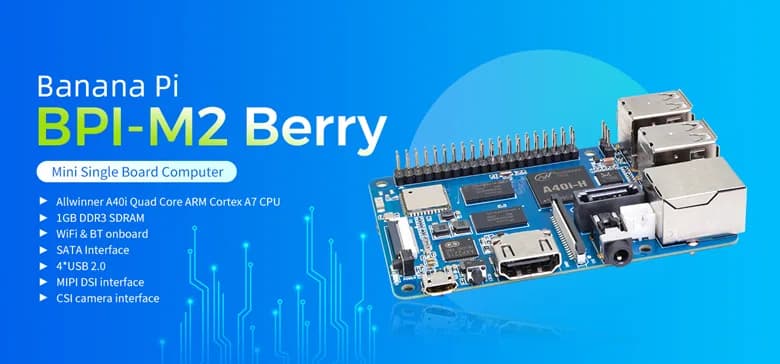
The Banana Pi BPI-M2 Berry is for hobbyists who want a small quad-core board with gigabit Ethernet, WiFi and a Raspberry Pi 3-style GPIO header. It suits light single-purpose jobs such as a sensor hub, a small network service or a GPIO project. It is less suited to anyone who needs more than 1GB of RAM, USB 3 or NVMe storage.

Typically about £46.99 in the UK when we researched itCheck price at Amazon UK (opens in a new tab, affiliate link)

Affiliate link. As an Amazon Associate I earn from qualifying purchases. Details

Scores, criterion by criterion

CriterionWeightBanana Pi BPI-M2 BerryOrange Pi 5 Plus
Software support30%5/105/10
Performance25%3/109/10
Storage15%4/109/10
I/O and networking15%6/108/10
Value15%4/107/10
Overall4.4/107.4/10

Specifications

SpecBanana Pi BPI-M2 BerryOrange Pi 5 Plus
Processor (SoC)Allwinner A40i/R40/V40; quad-core Cortex-A7 CPU; dual-core Mali-400 MP2 GPU at 500MHzRockchip RK3588 (8nm), four Cortex-A76 cores up to 2.4GHz and four Cortex-A55 cores up to 1.8GHz, Mali-G610 MP4 GPU, 6 TOPS NPU
Memory1GB DDR3 at 733MHz, shared with GPU4GB, 8GB, 16GB or 32GB (optional configurations)
Storage optionsMicroSD (TF) slot; SATA supported; no onboard eMMC; no M.2 or NVMe listedQSPI NOR flash 16MB/32MB, microSD slot, eMMC module socket (16GB to 256GB modules), M.2 M-key PCIe 3.0 x4 slot
Networking10/100/1000Mbps Ethernet (Realtek RTL8211E/D); WiFi 802.11 b/g/n (AP6212 module); Bluetooth 4.0Two 2.5G Ethernet ports; Wi-Fi/Bluetooth only via M.2 E-key module (not on board)
GPIO40-pin header with 28 GPIO; UART, I2C, SPI, PWM and I2S on some pins; matches Raspberry Pi 3 header40-pin expansion header (Raspberry Pi compatible) with GPIO, I2C, UART, SPI, CAN and PWM
Video outputsHDMI V1.4 TV-out; 4-lane MIPI DSI or RGB/LVDS panel; H.264 decode up to 1080p60Two HDMI outputs, one HDMI input, HDMI 2.1 8K output, Type-C DP1.4A, MIPI DSI
Power input5V/2A via micro USB; no 3.7V battery supportUSB-C power input, recommended 5V/4A supply; no USB PD negotiation

Strengths and weaknesses

Banana Pi BPI-M2 Berry

  • + Gigabit Ethernet, WiFi and Bluetooth 4.0 on board
  • + 40-pin header matches Raspberry Pi 3
  • + SATA supported alongside microSD
  • − Only 1GB RAM, shared with the GPU
  • − USB 2.0 only, no USB 3
  • − No eMMC, M.2 or NVMe

Skip it if:

  • Buyers who need more than 1GB of RAM for containers or VMs
  • Anyone who wants USB 3 or NVMe storage
  • Projects that need direct 3.7V battery power
Read the full Banana Pi BPI-M2 Berry review ›

Orange Pi 5 Plus

  • + Dual 2.5GbE ports and an M.2 PCIe 3.0 x4 slot
  • + RK3588 with RAM options up to 32GB
  • + Owners praise its low price for the hardware
  • − Mainline Linux is listed as not supported
  • − Heavy sustained loads need a heatsink or active cooling
  • − Wi-Fi and Bluetooth need an extra M.2 E-key module

Skip it if:

  • Beginners who want Raspberry Pi level software polish and community help
  • Anyone who needs mainline Linux support
  • Buyers who need built-in Wi-Fi and Bluetooth without adding a module
Read the full Orange Pi 5 Plus review ›

More comparisons

Compare all single-board computers · Best single-board computers