Banana Pi BPI-M2 Berry
~£46.99typical UK price when we researched itAffiliate link. As an Amazon Associate I earn from qualifying purchases. Details
Banana Pi BPI-M2 Berry review
Researched, not hands-on tested.How we review ›
by SudoPicks Research · editor Paul HR · published 29 Oct 2026 · updated 29 Oct 2026
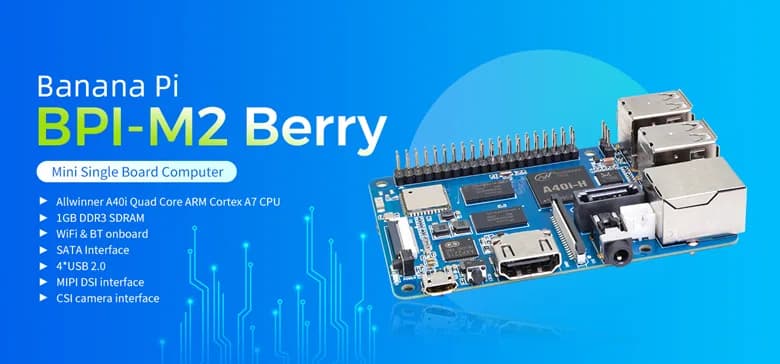
The Banana Pi BPI-M2 Berry is for hobbyists who want a small quad-core board with gigabit Ethernet, WiFi and a Raspberry Pi 3-style GPIO header. It suits light single-purpose jobs such as a sensor hub, a small network service or a GPIO project.
15th of 15 single-board computers we've reviewedAffiliate link. As an Amazon Associate I earn from qualifying purchases. Details
New to single-board computers? What they are and what to look for
A single-board computer, like a Raspberry Pi, is a tiny, cheap computer on one circuit board. People use them to learn coding, build gadgets, and run small home servers.
Do you need a single-board computer? Great for tinkering, learning Linux or electronics, or running things like a home-automation hub or ad blocker. Not a replacement for a normal PC.
What to look for
- A power supply, case and microSD card: they're often sold separately
- 4GB or more of memory for anything beyond simple projects
- How big the community is: more guides and help for popular boards
Unsure about a word? Jargon explained
How the 4.4 adds up
Our single-board computers rubric- Software support30% of score
- Performance25% of score
- Storage15% of score
- I/O and networking15% of score
- Value15% of score
Against the 15 single-board computers we've reviewed
bar = the range of all 15 · dot = this one · better →
- Overall score 4.4/1015th of 15
- Price £46.997th cheapest
- Value for money About average8th best of 12
Support and features
| Software updates | No end-of-support date found and no manufacturer statement on this source |
|---|
- Gigabit Ethernet
Measured by owners
No owner readings yet. If you own one and have a smart plug or power meter, a reading takes a minute and helps everyone else.
Security and compatibility
| Latest firmware or software | April 2022no update for over two years source |
|---|---|
| Known security issues | None found in public advisories. That's a good sign, not a guarantee. |
| Open firmware | Supported by OpenWrt |
| Update record | No advisory found for this board; the newest dated release in the notes is a 2022 maker image, and the maker's update record is unverified. |
| Linux | Partly works on Linux. Mainline Linux supports video, USB, Ethernet and SATA, but audio and U-Boot video output are missing, and Armbian lists the board as community-supported only. source |
Pros and cons
+ pros
- Gigabit Ethernet, WiFi and Bluetooth 4.0 on board
- 40-pin header matches Raspberry Pi 3
- SATA supported alongside microSD
− cons
- Only 1GB RAM, shared with the GPU
- USB 2.0 only, no USB 3
- No eMMC, M.2 or NVMe
Price history
Price history appears here once we have tracked this product for a few days.
The full review
Where it fits
The BPI-M2 Berry is a compact Allwinner-based board with a quad-core CPU, 1GB of RAM and a 40-pin GPIO header. The specification points to light, single-purpose work and GPIO projects rather than anything memory-hungry. It is a tinkerer's board more than a general-purpose server.
Processor and memory
The SoC is the Allwinner A40i/R40/V40. It has four Cortex-A7 cores and a dual-core Mali-400 MP2 GPU running at 500MHz. Memory is 1GB of DDR3 at 733MHz, and the GPU shares it.
With four A7 cores and a single 1GB tier shared with the GPU, the board suits one small service, a script runner or a dedicated sensor node. Running several containers would leave little headroom in that 1GB.
Storage4/10
The board has a microSD (TF) slot, and SATA is supported. There is no onboard eMMC, and no M.2 or NVMe. That leaves microSD and SATA as the storage options. If you plan to keep logs or databases on the board, a SATA drive gives you somewhere other than the card to put them.
Ports and networking6/10
Ethernet is 10/100/1000Mbps, using a Realtek RTL8211E/D controller. Wireless is 802.11 b/g/n through an AP6212 module, with Bluetooth 4.0 on the same board. Wired gigabit and built-in wireless suit a headless network appliance, a small monitoring box or a bridge between a wired and wireless setup.
USB is the weak spot. The board has four USB 2.0 host ports and one USB 2.0 OTG port, with no USB 3. Any external drive or adapter you plug in connects over USB 2.0, so SATA is the better choice for storage that matters.
The 40-pin header has 28 GPIO. UART, I2C, SPI, PWM and I2S are available on some pins. The header layout matches the Raspberry Pi 3, which will help if you are following GPIO guides written for that board. Check the pin functions you need before you commit, since the specification says these interfaces sit on some pins only.
Video and power
Video output is HDMI 1.4 for a TV. The board also supports a 4-lane MIPI DSI or RGB/LVDS panel. H.264 decode is listed up to 1080p60, which makes simple media playback and a small display project realistic.
Power comes in at 5V/2A over micro USB. The board has no 3.7V battery support, so it does not run directly from a single lithium cell. Plan for a 5V supply or a USB power bank.
Software5/10
The Banana Pi wiki has image sections for Android 6.0, Ubuntu, Debian, Raspbian, Armbian and others. That gives several starting points, from a Debian-family server install to an Android build for the display outputs. Check the release date and kernel version of any image before you build on it, because the wiki entries vary by section.
Bottom line
The BPI-M2 Berry offers gigabit Ethernet, WiFi, Bluetooth, SATA and a Raspberry Pi 3-style header on a board with four Cortex-A7 cores. Its limits are just as clear from the specification: 1GB of shared RAM, USB 2.0 throughout, and no eMMC, M.2 or NVMe. It fits small, low-demand projects where the connectivity matters more than the processing power.
Who should skip it
- Buyers who need more than 1GB of RAM for containers or VMs
- Anyone who wants USB 3 or NVMe storage
- Projects that need direct 3.7V battery power
Full specifications
| Processor (SoC) | Allwinner A40i/R40/V40; quad-core Cortex-A7 CPU; dual-core Mali-400 MP2 GPU at 500MHz |
|---|---|
| Memory | 1GB DDR3 at 733MHz, shared with GPU |
| Storage options | MicroSD (TF) slot; SATA supported; no onboard eMMC; no M.2 or NVMe listed |
| Networking | 10/100/1000Mbps Ethernet (Realtek RTL8211E/D); WiFi 802.11 b/g/n (AP6212 module); Bluetooth 4.0 |
| GPIO | 40-pin header with 28 GPIO; UART, I2C, SPI, PWM and I2S on some pins; matches Raspberry Pi 3 header |
| Video outputs | HDMI V1.4 TV-out; 4-lane MIPI DSI or RGB/LVDS panel; H.264 decode up to 1080p60 |
| Power input | 5V/2A via micro USB; no 3.7V battery support |
Alternatives
Compare head to head
- Banana Pi BPI-M2 Berry vs Banana Pi BPI-M2 ZERO ›
- Banana Pi BPI-M2 Berry vs BeagleBoard BeagleBone Black ›
- Banana Pi BPI-M2 Berry vs Arduino UNO Q 4GB (ABX00173) ›
- Banana Pi BPI-M2 Berry vs Raspberry Pi Zero WH ›
- Banana Pi BPI-M2 Berry vs IceWhale ZimaBoard 2 ›
- Banana Pi BPI-M2 Berry vs Raspberry Pi 3 Model B ›