GIGABYTE B850 AORUS ELITE WIFI7 (Rev. 1.x)
~£200typical UK price when we researched itAffiliate link. As an Amazon Associate I earn from qualifying purchases. Details
GIGABYTE B850 AORUS ELITE WIFI7 (Rev. 1.x) review
Researched, not hands-on tested.How we review ›
by SudoPicks Research · editor Paul HR · published 25 Oct 2026 · updated 25 Oct 2026
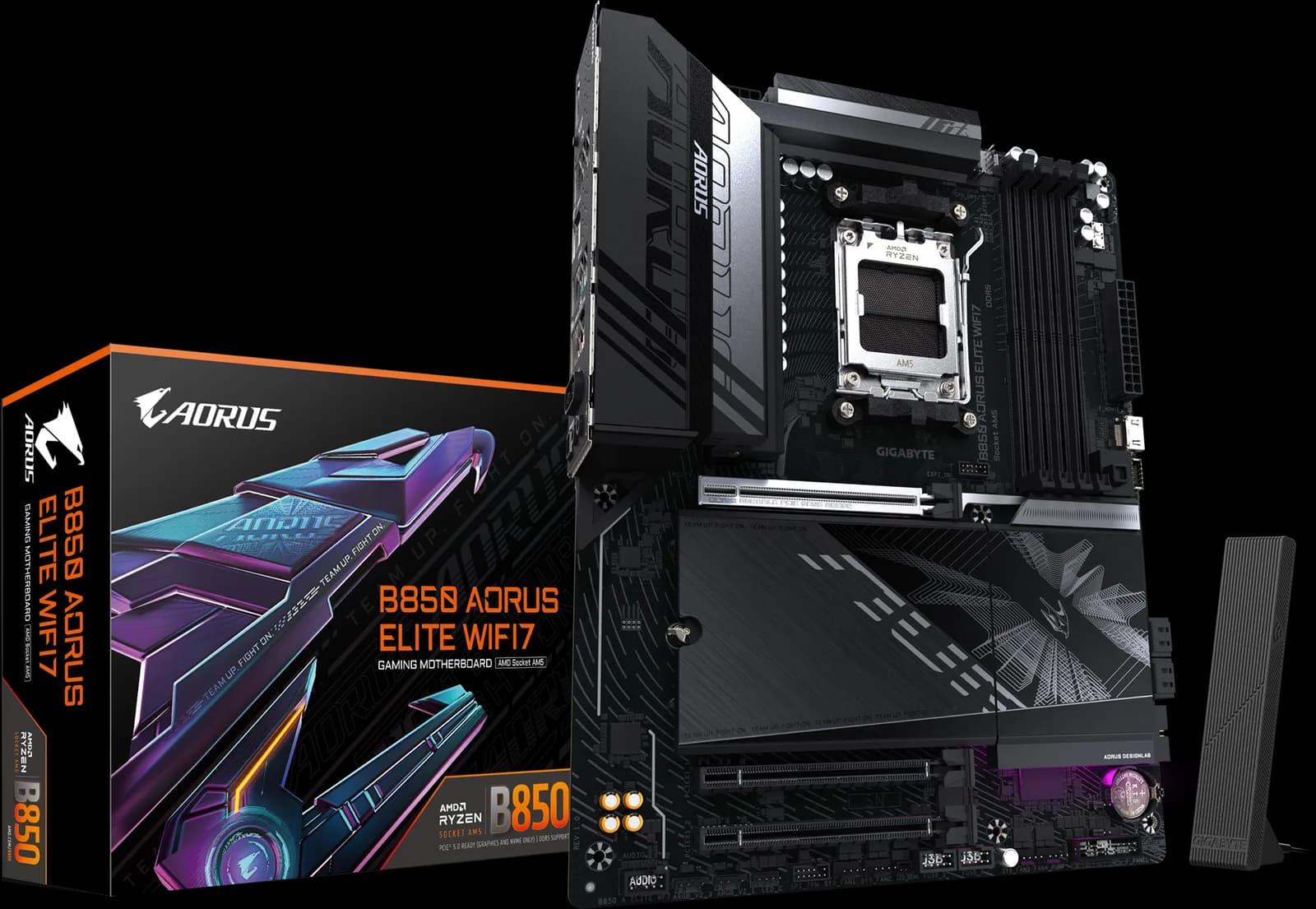
This is an AM5 board for Ryzen 7000 and 9000 builders who want a full-size B850 platform with Wi-Fi 7 and 2.5GbE. It suits people who need several NVMe drives, PCIe 5.0 for the graphics card and a fast front USB-C port.
8th of 16 motherboards we've reviewedAffiliate link. As an Amazon Associate I earn from qualifying purchases. Details
New to motherboards? What they are and what to look for
The motherboard is the main circuit board of a desktop PC. Every other part plugs into it: the processor, memory, graphics card, SSDs and the cables to the case.
Do you need a motherboard? Only if you're building or upgrading a desktop. Choose it after the processor, because the two must use the same socket.
What to look for
- The socket that matches your processor (AM5, AM4, LGA1851 or LGA1700)
- The size your case takes: ATX, Micro-ATX or Mini-ITX
- Enough M.2 slots, USB ports and built-in Wi-Fi or 2.5GbE if you want them
Unsure about a word? Jargon explained
How the 6.7 adds up
Our motherboards rubric- Platform and features25% of score
- Connectivity25% of score
- Power delivery20% of score
- BIOS and support15% of score
- Value15% of score
Against the 16 motherboards we've reviewed
bar = the range of all 16 · dot = this one · better →
- Overall score 6.7/108th of 16
- Price £20011th cheapest
- Value for money About average9th best of 15
Support and features
| Software updates | No end date announced; latest BIOS seen is AGESA 1.2.8.0. source |
|---|
Compatibility
| Linux | Partly works on Linux. Owner reports show it running under several distributions, but Gigabyte supplies no Linux drivers and Wi-Fi threads report problems with the Realtek 8922AE chip. source |
|---|
Pros and cons
+ pros
- PCIe 5.0 for graphics slot and primary M.2 slot
- Front USB-C header runs at 20Gbps
- 14+2+2 phase design with 60A DrMOS on CPU rail
− cons
- Fastest rear USB port is 10Gbps
- Wi-Fi 7 needs Windows 11; no Windows 10 driver
- Both chipset PCIe slots run at x1 only
Price history
Price history appears here once we have tracked this product for a few days.
The full review
Where it fits
The B850 AORUS ELITE WIFI7 is an AM5 board built on the AMD B850 chipset. It supports Ryzen 9000 and 7000 chips. A retailer lists it as ATX. It has four DDR5 DIMM slots, supports up to 256GB (64GB per DIMM) in dual channel, and lists speeds up to 8200 MT/s with overclocking profiles.
It is a general-purpose desktop board. The feature list leans towards storage, networking and a single fast graphics card rather than multi-card expansion.
Storage and expansion
There are three M.2 slots. The primary one, M2A_CPU, runs PCIe 5.0 x4/x2 from the CPU. The second, M2B_CPU, runs PCIe 4.0 x4/x2 from the CPU. The third, M2C_SB, runs PCIe 4.0 x4/x2 from the chipset. That gives you one PCIe 5.0 drive and two PCIe 4.0 drives.
Four SATA 6Gb/s ports cover older drives and bulk storage. NVMe RAID supports 0, 1, 5 and 10, with RAID 5 available only on Ryzen 9000. If you plan a RAID 5 array on a Ryzen 7000 chip, that limit matters.
The PCIe 5.0 x16 slot comes straight from the CPU and suits a single graphics card. The other two slots are x16-length but run at x1 from the chipset, and they use PCIe 3.0. With those limits, they suit a capture card, extra network card or similar low-bandwidth add-in. They are a poor fit for anything that needs a wide link.
Connectivity7/10
Networking is a Realtek 2.5GbE RJ-45 port (2.5/1/0.1 Gbps) plus Realtek Wi-Fi 7 (RTL8922AE) with Bluetooth 5.4. Wi-Fi 7 needs Windows 11, and there is no Windows 10 driver. A Windows 10 machine would have to rely on the wired port.
There are 12 rear USB ports. One is a USB-C port at USB 3.2 Gen 2 (10Gbps). Two are USB 3.2 Gen 2 Type-A. Five are USB 3.2 Gen 1, and four are USB 2.0/1.1. Port count is generous. Speed tops out at 10Gbps at the back, though, so fast external SSDs get a 10Gbps ceiling on the rear panel.
The board adds one internal front USB-C header at USB 3.2 Gen 2x2 (20Gbps). A case with a matching front USB-C connector can therefore reach the faster speed from the front.
Power delivery and cooling7/10
The board uses a twin digital 14+2+2 phase design. That means 14 phases on the CPU rail with 60A DrMOS, plus 2 SOC and 2 MISC phases.
Reviewer measurements give a mixed picture. Tom's Hardware reports VRM peaks of 43°C from probes and 46°C from the sensor during a stress test. A second reviewer measured 87°C after 30-minute Cinebench loops using a 360mm AIO. That reviewer also reported a Ryzen 9 9950X reaching its 95°C thermal cap. The two reports describe different tests, so treat the numbers as a range.
BIOS and support6/10
BIOS F1, dated 27 September 2024, added AGESA 1.2.0.1a, TDP 65–105W selection and a Sinkclose fix. A later BIOS with AGESA 1.2.8.0 adds Ryzen 9950X3D2 support and improves BitLocker compatibility with a discrete GPU. GIGABYTE has kept the board current with new CPU support and fixes.
The BIOS history shows steady updates. Because the 9950X3D2 support arrives only in the later release, anyone buying for that chip should check which BIOS version the board ships with.
Who it suits
The board suits a Ryzen 7000 or 9000 build that needs one PCIe 5.0 graphics card, up to three NVMe drives and a front 20Gbps port. Wi-Fi 7 and 2.5GbE cover networking, provided you run Windows 11 for the wireless side. Its limits are the 10Gbps rear USB ceiling and the x1 chipset slots. Builders who need faster rear ports or several wide expansion cards should check those two points first.
Who should skip it
- Windows 10 users who want to use the Wi-Fi 7 adapter
- Buyers who need rear USB faster than 10Gbps
- Builders planning several wide PCIe expansion cards
Full specifications
| CPU socket (e.g. AM5, AM4, LGA1851, LGA1700) | AM5 |
|---|---|
| Chipset | AMD B850 |
| Form factor (ATX, Micro-ATX, Mini-ITX, E-ATX) | ATX (retailer listing; not confirmed on the manufacturer page) |
| Memory: type (DDR4 or DDR5), number of slots, maximum capacity and speed | DDR5, 4 DIMM slots, up to 256 GB (64 GB per DIMM), dual channel, base speeds 5200/4800/4400 MT/s, up to 8200 MT/s with overclocking profiles |
| M.2 NVMe slots and their PCIe generation | Three M.2 slots: M2A_CPU PCIe 5.0 x4/x2 (Ryzen 9000/7000); M2B_CPU PCIe 4.0 x4/x2 (Ryzen 9000/7000); M2C_SB PCIe 4.0 x4/x2 (chipset) |
| PCIe slots | One PCIe 5.0 x16 slot from the CPU; two PCIe 3.0 x16-length slots running at x1 from the chipset |
| Wired and wireless networking (e.g. 2.5GbE, Wi-Fi 7) | Realtek 2.5GbE RJ-45 LAN (2.5/1/0.1 Gbps); Realtek Wi-Fi 7 RTL8922AE with Bluetooth 5.4 |
| Rear USB ports, including USB-C and USB4 | Rear: 1 x USB-C USB 3.2 Gen 2 (10 Gbps), 2 x USB 3.2 Gen 2 Type-A, 5 x USB 3.2 Gen 1, 4 x USB 2.0/1.1; 12 rear ports in total |
Sources
- B850 AORUS ELITE WIFI7 (Rev. 1.x) specifications
- B850 AORUS ELITE WIFI7 key features (US)
- B850 AORUS ELITE WIFI7 support and BIOS history
- B850 AORUS ELITE WIFI7 user manual
- Newegg listing: GIGABYTE B850 AORUS ELITE WIFI7
- Tom's Hardware review: GIGABYTE B850 AORUS ELITE WIFI7
- TechPowerUp review: GIGABYTE B850 AORUS ELITE WI-FI 7
- The FPS Review: GIGABYTE B850 AORUS ELITE WIFI7
- Overclockers review: GIGABYTE B850 AORUS ELITE WIFI7 ICE
- Glitched Online review: B850 AORUS ELITE WI-FI 7
Alternatives
Compare head to head
- GIGABYTE B850 AORUS ELITE WIFI7 (Rev. 1.x) vs ASUS ROG STRIX B850-F GAMING WIFI ›
- GIGABYTE B850 AORUS ELITE WIFI7 (Rev. 1.x) vs ASUS TUF GAMING B760-PLUS WIFI D4 ›
- GIGABYTE B850 AORUS ELITE WIFI7 (Rev. 1.x) vs ASUS ROG STRIX B860-I GAMING WIFI ›
- GIGABYTE B850 AORUS ELITE WIFI7 (Rev. 1.x) vs MSI MAG X870 TOMAHAWK WIFI ›
- GIGABYTE B850 AORUS ELITE WIFI7 (Rev. 1.x) vs GIGABYTE B650M AORUS ELITE AX ›
- GIGABYTE B850 AORUS ELITE WIFI7 (Rev. 1.x) vs ASUS TUF GAMING B850-PLUS WIFI ›