TL-SG1005LP
Price unavailable right nowAffiliate link. As an Amazon Associate I earn from qualifying purchases. Details
TL-SG1005LP review
Researched, not hands-on tested.How we review ›
by SudoPicks Research · published 24 Oct 2026 · updated 24 Oct 2026
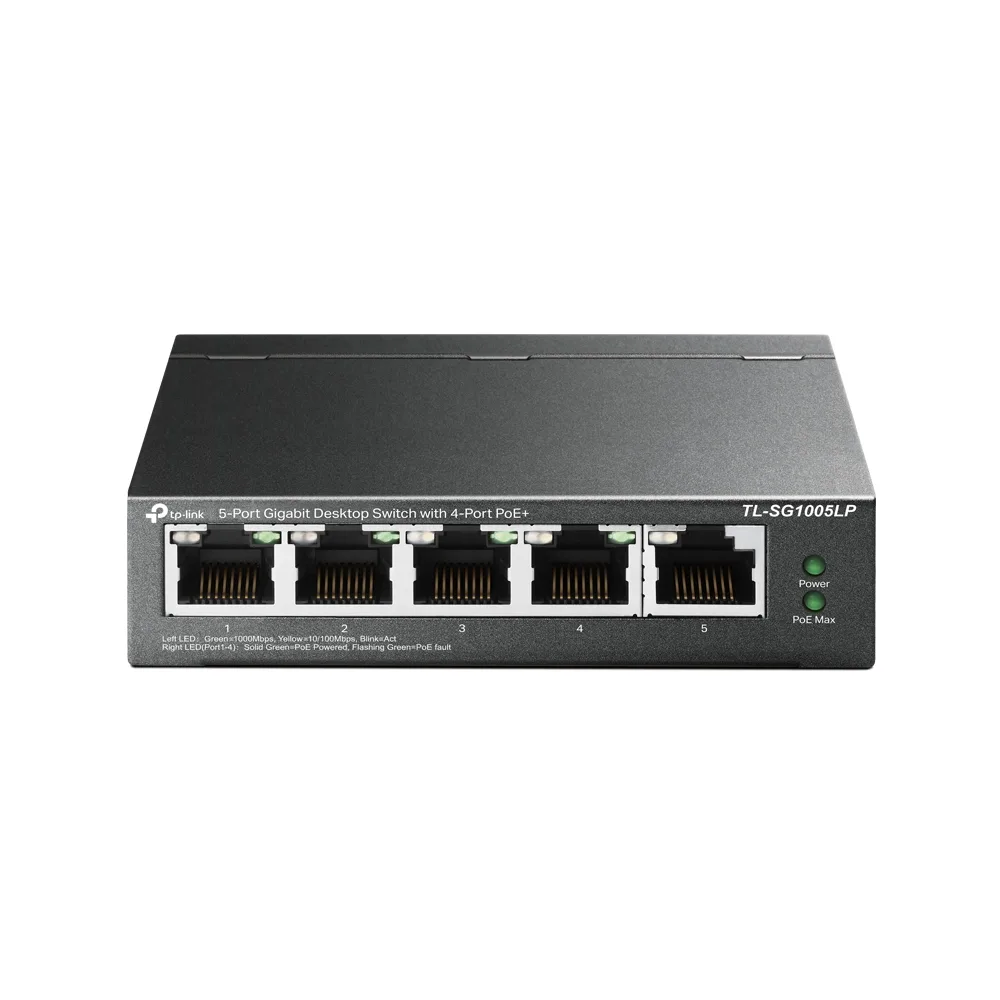
The TL-SG1005LP is for anyone who wants a small, unmanaged Gigabit switch that also powers a few PoE devices. It suits a desk, shelf or cupboard setup where silence matters and VLANs are not needed.
joint 5th of 10 network switches we've reviewedAffiliate link. As an Amazon Associate I earn from qualifying purchases. Details
How the 6.1 adds up
Our network switches rubric- Port speeds30% of score
- Management20% of score
- Port count and uplinks15% of score
- PoE10% of score
- Noise and efficiency15% of score
- Firmware and support10% of score
Against the 10 network switches we've reviewed
bar = the range of all 10 · dot = this one · better →
- Overall score 6.1/10joint 5th of 10
- Price £29.996th cheapest
- Value for money 20.3 per £1006th of 10
Running costs and support
| Power draw | 46.9W under load (manufacturer's figure, source) |
|---|---|
| Software updates | No end-of-support date found for this model. source |
- PoE
- Fanless
Featured in: Best network switches with PoE · Best network switches that are silent
Pros and cons
+ pros
- Four PoE+ ports at up to 30 W each
- Fanless design
- Plug-and-play with no setup
− cons
- Gigabit only; no 2.5GbE or 10GbE
- 40 W total PoE budget is shared
- No web UI, VLAN or SNMP
Price history
Price history appears here once we have tracked this product for a few days.
The full review
Where it fits
The TL-SG1005LP is a five-port unmanaged switch from TP-Link. All five ports are 10/100/1000 RJ45. Ports 1 to 4 supply PoE+, and port 5 is a standard data port. It is plug-and-play, so there is nothing to configure.
That shapes who it suits. It is a simple way to add a few wired connections and power a handful of PoE devices from one small box. It is not a switch for anyone who wants to segment a network.
Ports and speedsPort speeds 6/10Port count and uplinks 5/10
Every port runs at up to 1Gbps. The specifications list no 2.5GbE or 10GbE port, and no SFP uplink: all five ports are RJ45. If you need anything faster than Gigabit, this model does not offer it.
The port layout is straightforward. Ports 1 to 4 carry PoE and port 5 does not, so a router or upstream connection on port 5 leaves four ports for powered devices.
TP-Link lists a switch capacity of 10 Gbps, a 2K MAC address table and a 1 Mbit packet buffer. Jumbo frame support is listed as 9 KB on the V4 hardware and 16 KB on V3. Check which version you are buying if jumbo frames matter to you.
PoE and the power budget
The PoE side is the main reason to look at this switch. Ports 1 to 4 support 802.3af and 802.3at, with up to 30 W per port. The total PoE budget is 40 W.
That total is the limit that matters. Four ports at 30 W each would come to 120 W, so the 40 W budget is shared across all four. TP-Link says intelligent power management cuts lower-priority ports when the budget is exceeded. Add up the rated draw of the devices you plan to connect before you buy, and keep it under 40 W.
The V4 datasheet lists a maximum power consumption of 46.9 W.
Management5/10
This is an unmanaged switch. The specifications list no web UI, no VLAN support and no SNMP. With none of those, you cannot split traffic into VLANs or monitor the switch over SNMP. What you get instead is a switch that works when you plug it in.
For a flat home or small office network, that may be all you need. For a homelab that uses VLANs to separate servers, IoT devices and guests, it falls short. You would need a managed model for that.
Noise and heat9/10
TP-Link's UK page lists a fanless design. With no fan, there is no fan noise to consider in a quiet room or on a desk. The datasheet gives a maximum heat dissipation of 159.46 BTU/h. Because that figure comes from the same hardware that carries up to 40 W of PoE load, leave some airflow around the case rather than packing it into a tight space.
Firmware and supportPort speeds 6/10Port count and uplinks 5/10Firmware and support 5/10
Because the switch is unmanaged, there is no management firmware to configure. TP-Link has a UK support downloads page for the model, and datasheets exist for both V3 and V4. No firmware update history is listed.
One retailer lists the warranty as limited lifetime. TP-Link's own warranty page does not confirm that, so check the terms with the seller before relying on it.
Who it suits
The switch suits a small setup with a few PoE devices and a router on the spare port. Its fanless build and no-configuration setup fit a quiet desk or cupboard. If your devices together draw more than 40 W, or you need VLANs, faster ports or fibre uplinks, the listed specifications show it cannot do that.
Who should skip it
- Buyers who need VLANs, a web UI or SNMP monitoring
- Anyone who needs 2.5GbE, 10GbE or SFP uplinks
- Buyers whose PoE devices draw more than 40 W combined
Full specifications
| Ports | 5x 10/100/1000 Mbps RJ45; ports 1-4 are PoE+ |
|---|---|
| Port speeds | 10/100/1000 Mbps on all five ports; no 2.5GbE or 10GbE port listed |
| Management | Unmanaged, plug-and-play; no web UI, VLAN or SNMP listed |
| PoE budget | 802.3af/at on ports 1-4, up to 30 W per port, 40 W total budget |
| Uplinks (SFP/SFP+) | None listed; all five ports are RJ45 |
| Switching capacity | Switch capacity 10 Gbps; MAC table 2K; packet buffer 1 Mbit; jumbo frame 9 KB (V4) or 16 KB (V3) |
| Cooling | Fanless; max heat dissipation 159.46 BTU/h |