WD_BLACK SN7100 2TB NVMe SSD
Price unavailable right nowAffiliate link. As an Amazon Associate I earn from qualifying purchases. Details
WD_BLACK SN7100 2TB NVMe SSD review
Researched, not hands-on tested.How we review ›
by SudoPicks Research · published 24 Oct 2026 · updated 24 Oct 2026
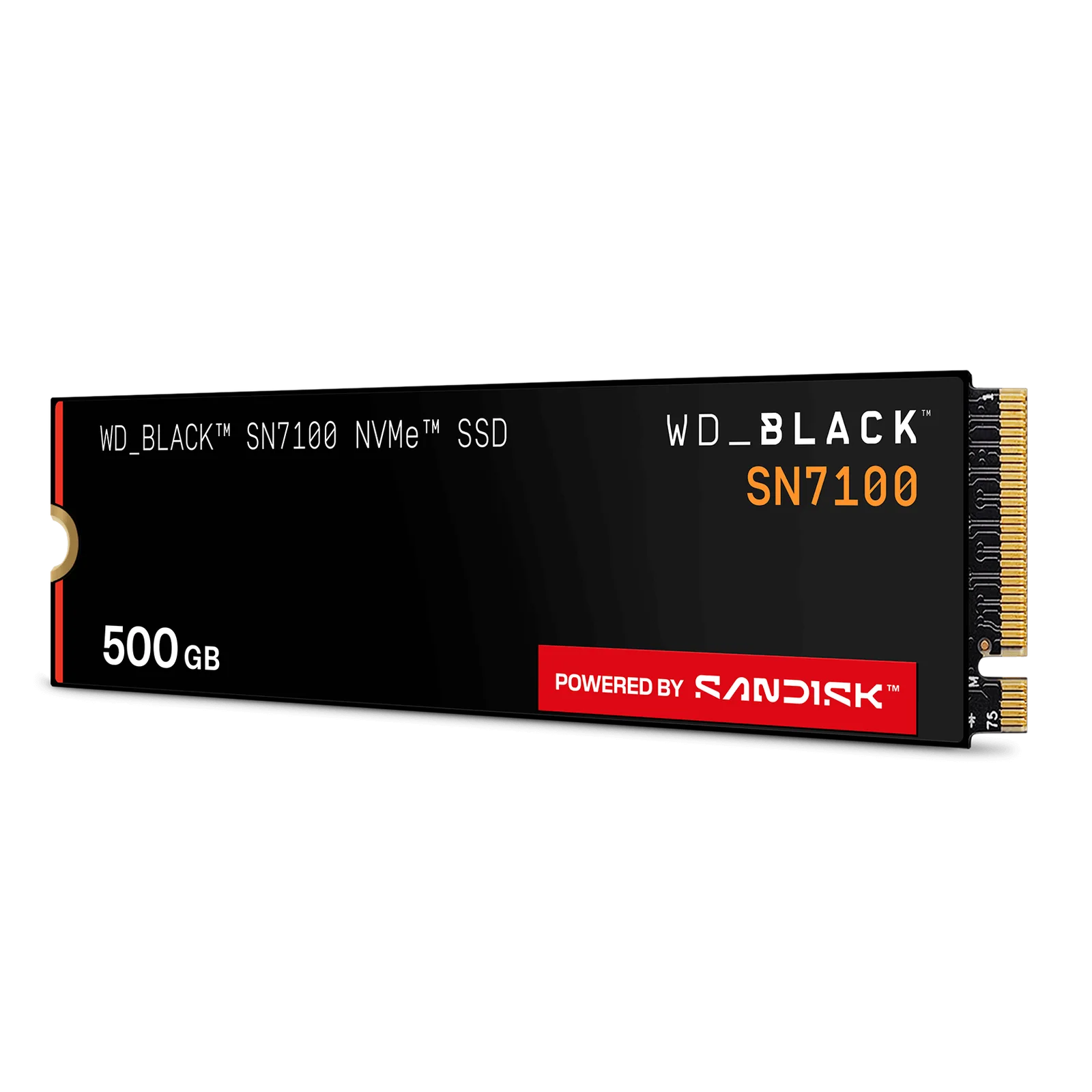
The WD_BLACK SN7100 2TB is for buyers who want a PCIe Gen 4x4 M.2 2280 drive with low power draw. It suits desktops and Windows machines where the Dashboard software is usable.
3rd of 9 NVMe SSDs we've reviewedAffiliate link. As an Amazon Associate I earn from qualifying purchases. Details
New to NVMe SSDs? What they are and what to look for
An NVMe SSD is a stick-shaped drive that plugs straight into a computer's motherboard. It's the fastest common kind of storage and makes a computer start and load programs quickly.
Do you need an NVMe SSD? Useful if you're building or upgrading a PC, adding space to a PlayStation 5, or replacing a slow hard drive. Check your computer has a free M.2 slot first.
What to look for
- Capacity: 1TB is a sensible minimum, 2TB for games
- PCIe 4.0 is plenty for almost everyone; 5.0 only helps in a few tasks
- Endurance (TBW) and warranty length, which show how long it's built to last
Unsure about a word? Jargon explained
How the 7.0 adds up
Our NVMe SSDs rubric- Performance35% of score
- Endurance20% of score
- Warranty15% of score
- Efficiency and thermals15% of score
- Software15% of score
Against the 9 NVMe SSDs we've reviewed
bar = the range of all 9 · dot = this one · better →
- Overall score 7.0/103rd of 9
- Price £2708th cheapest
- Value for money 2.6 per £1006th of 9
Running costs and support
| Power draw | 0.969W idle, 3W under load (measured by owners or reviewers, source) |
|---|---|
| Software updates | No end-of-support date announced; manufacturer points to successor Optimus GX 7100. source |
- PCIe 5.0
Compatibility
| Linux | Partly works on Linux. Maker software is Windows-only and no maker Linux support is stated, but one Framework Community user reports a successful firmware update on Linux using nvme tooling. source |
|---|
Pros and cons
+ pros
- Rated 7,250 MB/s read and 6,900 MB/s write
- 1,200 TBW and a five-year warranty
- Low measured power draw during transfers
− cons
- Dashboard software is Windows-only
- No heatsink variant listed
- Owner complaints about laptop idle power and ASPM
Price history
Price history appears here once we have tracked this product for a few days.
The full review
Where it fits
The WD_BLACK SN7100 2TB is a PCIe Gen 4x4 NVMe drive in the M.2 2280 format. It was released on 21 November 2024. Sandisk lists it under the Sandisk brand with WD_BLACK branding, and the model number is WDS200T4X0E-00CJA0.
It is a general-purpose fast drive for a desktop or laptop with a standard M.2 2280 slot. Its main selling point in the research is efficiency rather than raw speed.
Performance7/10
WD rates the drive at up to 7,250 MB/s sequential read and up to 6,900 MB/s sequential write. Random performance is rated at 1,000K IOPS for reads and 1,400K IOPS for writes.
Those are peak ratings. The "up to" wording on the sequential figures means real transfers can be slower, and the research gives no sustained-write numbers. For a boot drive, a project workspace or a game library, these ratings are the only performance figures the research provides.
Power draw
This is where owner and reviewer feedback is most positive. One reviewer measured average power of about 3 W and a maximum of 4.10 W during transfers. The same reviewer's figures for the SN850X were 4 W and 6.83 W. TechPowerUp calls the SN7100 the most efficient SSD tested.
Idle power is less clear. A figure of 0.969 W with L1 ASPM enabled appears on ssdwiki, but its source is unclear and it is not a wall measurement. Owner figures conflict: about 1 W in a Framework community thread, and 0.03 W in a cited Japanese measurement. Owner feedback also includes a complaint that the drive never enters the lowest ASPM state in mobile idle.
With that mixed idle picture, laptop buyers who care about battery life should read the Framework thread before buying. Desktop buyers are less exposed, since the praise concerns power during transfers.
Heat and heatsinks
The datasheet lists no heatsink variant, and the sources read did not publish any heatsink SKUs. Buyers who want a heatsink fitted to the drive itself have no listed option. The lower measured power during transfers is a point in its favour for heat, but the research contains no temperature figures.
Endurance and warrantyEndurance 8/10Warranty 9/10
Endurance is rated at 1,200 TBW for the 2TB capacity. The warranty is five years limited, or until the Max Endurance TBW limit is reached, whichever comes first. The TBW figure therefore matters as much as the five years. For a workstation or homelab host with heavy, constant writes, that limit is the number to check against your expected workload.
Software4/10
The SANDISK Dashboard software is Windows-only. macOS and Linux users get no health monitoring from it. That is a real gap for homelabbers and developers who run Linux, since the manufacturer's own tool does not cover them. The research does not describe firmware update tooling or a firmware track record, so there is nothing to say about either.
Product lifecycle
The manufacturer's page names a successor, the SANDISK Optimus GX 7100 NVMe SSD. The research describes this as a successor-line notice, not an end-of-life notice, and no end-of-support date was found. Anyone planning a purchase around long-term availability may want to watch how the successor line develops.
Who it suits
The SN7100 2TB suits buyers with a Windows desktop or a Windows laptop who value low power draw during transfers and a five-year warranty backed by 1,200 TBW. Its limitations are specific. Dashboard is Windows-only, no heatsink version is listed, and some laptop owners report idle-power and ASPM problems. Check those against your own setup before you buy.
What owners report
Recurring themes from public owner feedback, summarised in our own words.
- Owners and reviewers praise its power efficiency, with TechPowerUp calling it the most efficient SSD tested.
- Laptop users complain about idle power, saying it never enters the lowest ASPM state in mobile idle.
- Reported idle power figures conflict, ranging from about 0.03 W to about 1 W.
Who should skip it
- Linux or macOS users who want manufacturer health-monitoring software
- Buyers who want a drive with a factory-fitted heatsink
- Laptop owners who prioritise the lowest possible idle power
Full specifications
| Interface | PCIe Gen 4x4 NVMe |
|---|---|
| Sequential read | 7,250 MB/s (up to) |
| Sequential write | 6,900 MB/s (up to) |
| Endurance (2TB) | 1,200 TBW (2TB) |
| Form factor | M.2 2280 |
| Warranty | 5-year limited (or Max Endurance TBW limit, whichever occurs first) |
Sources
- WD_BLACK SN7100 NVMe Internal SSD product page (Sandisk)
- WD_BLACK SN7100 datasheet (Sandisk)
- Western Digital newsroom press release, 21 Nov 2024
- Newegg listing, WD 2TB SN7100
- TechPowerUp WD_BLACK SN7100 2TB review
- Storedbits WD_BLACK SN7100 vs SN850X
- Androidexperto WD_BLACK SN7100 review
- GamingPCGuru WD_BLACK SN7100 2TB review
- Vividrepairs WD_BLACK SN7100 2TB NVMe SSD review
- ssdwiki WD_BLACK SN7100 spec database
- Framework community thread on SN770/SN7100 idle power draw
Alternatives
Compare head to head
- WD_BLACK SN7100 2TB NVMe SSD vs Crucial P510 1TB PCIe Gen5 NVMe M.2 SSD ›
- WD_BLACK SN7100 2TB NVMe SSD vs WD_BLACK SN850X NVMe SSD 1TB ›
- WD_BLACK SN7100 2TB NVMe SSD vs Samsung 990 PRO 2TB ›
- WD_BLACK SN7100 2TB NVMe SSD vs Lexar EQ790 M.2 2280 PCIe Gen4x4 NVMe SSD ›
- WD_BLACK SN7100 2TB NVMe SSD vs Acer Predator GM7 PCIe 4.0 M.2 SSD 1TB ›
- WD_BLACK SN7100 2TB NVMe SSD vs BIWIN Black Opal NV7400 Gen4 SSD 1TB ›