MSI GeForce RTX 5060 Ti 8G GAMING TRIO OC
Price unavailable right nowAffiliate link. As an Amazon Associate I earn from qualifying purchases. Details
MSI GeForce RTX 5060 Ti 8G GAMING TRIO OC review
Researched, not hands-on tested.How we review ›
by SudoPicks Research · published 24 Oct 2026 · updated 24 Oct 2026
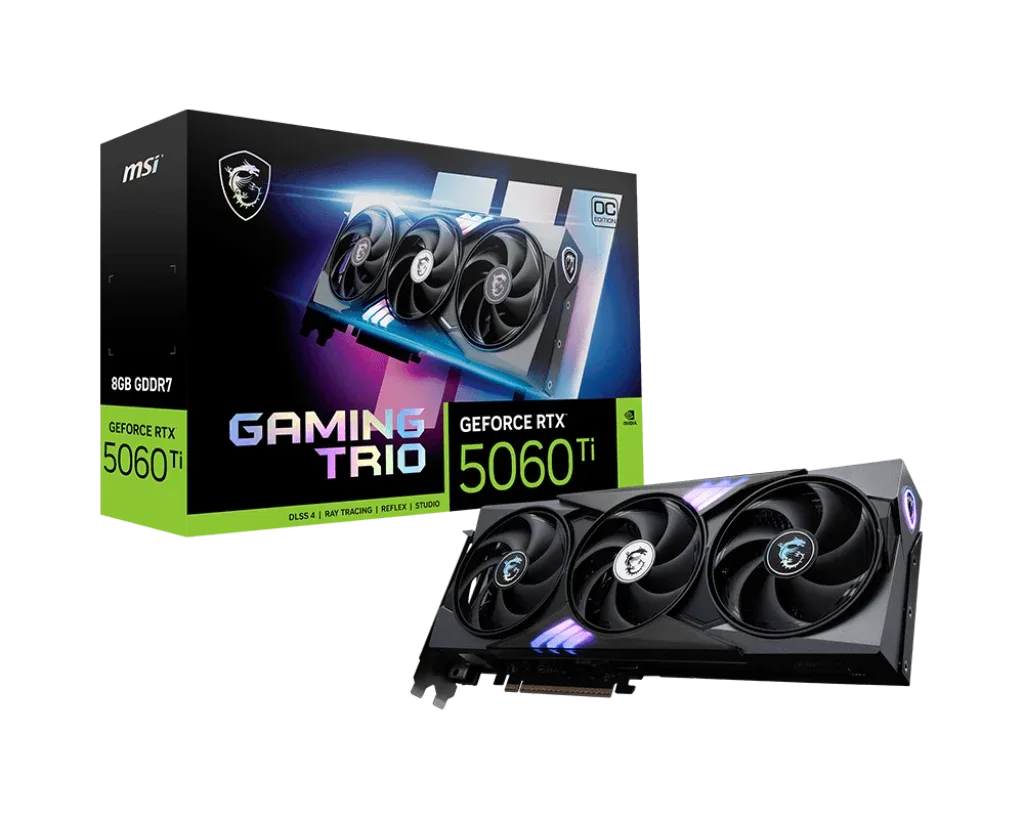
This is an 8GB RTX 5060 Ti with MSI's TRI FROZR 4 cooler, aimed at gamers who want a quiet card at 180 W. It suits builders with a case that takes a 300 mm card and a PSU with a 16-pin connector.
4th of 5 graphics cards we've reviewedAffiliate link. As an Amazon Associate I earn from qualifying purchases. Details
New to graphics cards? What they are and what to look for
A graphics card (GPU) draws the picture for games and speeds up video editing and AI tools. It fits inside a desktop PC.
Do you need a graphics card? Needed for modern PC gaming and running AI models at home. Not needed for office work, browsing or video streaming.
What to look for
- Enough video memory: 12GB or more for new games and AI
- That it physically fits your case and power supply
- Noise and power use
Unsure about a word? Jargon explained
How the 5.3 adds up
Our graphics cards rubric- Performance30% of score
- Video memory25% of score
- Software support15% of score
- Efficiency and noise15% of score
- Size and fit10% of score
- Build and warranty5% of score
Against the 5 graphics cards we've reviewed
bar = the range of all 5 · dot = this one · better →
- Overall score 5.3/104th of 5
- Price £429.992nd cheapest
- Value for money 1.2 per £1002nd of 5
Running costs and support
| Power draw | 180W under load (manufacturer's figure, source) |
|---|---|
| Software updates | No end date announced for software or firmware support; the search was limited. |
Compatibility
| Linux | Partly works on Linux. Linux users report that Nvidia's 570.153.02 driver supports the RTX 5060 Ti chip generally, but no MSI Linux utility or board-specific Linux confirmation was found. source |
|---|
Pros and cons
+ pros
- Cooler praised as quiet and cool under gaming load
- 180 W board power with a 600 W PSU recommended
- Three DisplayPort 2.1b outputs plus HDMI 2.1b
− cons
- 8GB of VRAM limits 1440p ultra textures
- Two reviews report audible coil whine
- Long 300 mm card needing a 16-pin connector
Price history
Price history appears here once we have tracked this product for a few days.
The full review
Where it fits
This is MSI's GeForce RTX 5060 Ti 8G GAMING TRIO OC. It uses the RTX 5060 Ti GPU with 4608 CUDA cores and 8GB of GDDR7 on a 128-bit bus running at 28 Gbps. MSI lists a boost clock of 2647 MHz, and an Extreme Performance profile of 2662 MHz through MSI Center. The card connects over PCI Express Gen 5 x16 but uses x8 of it.
The research separates this card from the 8G GAMING OC, which is a different and shorter card at 247 x 135 x 51 mm. This one measures 300 x 125 x 44 mm, so check your case clearance before buying.
Memory is the main limit3/10
The 8GB of VRAM is the headline limitation. One review described it as a restriction at 1440p with ultra textures in modern titles. That is a single review, so treat it as one reviewer's view rather than a settled one.
The same ceiling matters for local AI work. Model size is bound by VRAM, and 8GB leaves little room for larger models. If you want to run language models or image generation at home, a card with more memory fits that job better.
The research does not give benchmark figures, so there is no frame-rate data to quote here. The performance case rests on the GPU tier and the factory clocks.
Cooling, noise and coil whine7/10
MSI fits its TRI FROZR 4 cooler, with three STORMFORCE fans and a nickel-plated copper baseplate. Reviewers praised the cooling and fan noise, describing the card as quiet and cool under gaming load. Those comments come from reviews of the 16GB version and from an Alktech review. The 16GB card uses the same Trio cooler name, but the research does not confirm the two behave identically.
Coil whine is the caveat. Two independent reviews reported audible coil whine. Guru3d's report was on the 16GB card, and the research has nothing on whether the 8GB card behaves the same. Treat it as a risk rather than a certainty. If you build a quiet system, factor that in.
Board power is rated at 180 W by MSI, with a 600 W PSU recommended. That is a modest power budget, which helps if your supply is not large.
Size, power and connections5/10
At 300 mm long, this card needs a roomy case. MSI lists the dimensions as 300 x 125 x 44 mm, though the research does not label each figure or state a slot count, so measure the space beside the card as well as its length.
Power comes through a single 16-pin connector, and MSI recommends an ATX 3.1 PSU. If your supply lacks that connector, check what the manufacturer and PSU maker say before ordering.
For displays, you get three DisplayPort 2.1b outputs and one HDMI 2.1b output. It supports up to four displays, which suits a multi-monitor desk.
Software and drivers6/10
The card is an NVIDIA GeForce part with CUDA cores, which is the base for CUDA-based AI tools. The research does not cover Linux driver behaviour or AV1 encoding for Plex or Jellyfin, so those points are not assessed here. Check them against NVIDIA's documentation if either matters to your setup.
Who it suits
With 180 W board power, a cooler that reviewers describe as quiet, and a 300 mm body, this card suits a gaming desktop with room to spare. The 8GB of memory is the main thing to weigh if you play at 1440p with ultra textures or want to run large AI models. Coil whine reports mean you should keep the return option in mind if noise matters to you.
What owners report
Recurring themes from public owner feedback, summarised in our own words.
- Reviewers describe the cooler as quiet and cool under gaming load, based on reviews of the 16GB version and Alktech.
- Two independent reviews report audible coil whine, with Guru3d's report covering the 16GB card.
- A single review sees 8GB of VRAM as a limitation at 1440p with ultra textures.
Who should skip it
- Buyers who want to run larger local AI models and need more than 8GB of VRAM
- Gamers who want 1440p with ultra textures in modern titles
- Builders with compact cases that cannot fit a 300 mm card or a 16-pin power connector
Full specifications
| GPU | NVIDIA GeForce RTX 5060 Ti, 4608 CUDA cores, PCI Express Gen 5 x16 (uses x8), core clock Extreme Performance 2662 MHz (MSI Center), Boost 2647 MHz |
|---|---|
| Video memory | 8GB GDDR7, 128-bit bus, 28 Gbps |
| Board power | 180 W board power; recommended PSU 600 W |
| Length and slots | 300 x 125 x 44 mm |
| Display outputs | DisplayPort x 3 (v2.1b) and HDMI x 1 (HDMI 2.1b), up to 4 displays |
| Power connector | 16-pin x 1 (ATX 3.1 PSU recommended) |
Sources
- MSI GeForce RTX 5060 Ti 8G GAMING TRIO OC specification
- MSI GeForce RTX 5060 Ti 8G GAMING TRIO OC overview
- MSI UK store listing
- VIVID Repairs GeForce RTX 5060 Ti 8G GAMING TRIO OC review
- TechPowerUp MSI RTX 5060 Ti Gaming Trio 16 GB review (noise, encoder)
- Guru3d MSI RTX 5060 Ti Trio OC review
- Wccftech MSI RTX 5060 Ti Gaming Trio OC review
- Alktech MSI RTX 5060 Ti 16G Gaming Trio OC review
- Mezha MSI GeForce RTX 5060 Ti 8G Gaming Trio OC review
- Guru3d forum thread on MSI RTX 5060 Ti Trio OC review
Alternatives
Compare head to head
- MSI GeForce RTX 5060 Ti 8G GAMING TRIO OC vs ASUS Dual GeForce RTX 5060 8GB GDDR7 OC Edition ›
- MSI GeForce RTX 5060 Ti 8G GAMING TRIO OC vs PowerColor Reaper AMD Radeon RX 9070 XT 16GB GDDR6 ›
- MSI GeForce RTX 5060 Ti 8G GAMING TRIO OC vs GIGABYTE Radeon RX 9070 XT GAMING OC 16G ›
- MSI GeForce RTX 5060 Ti 8G GAMING TRIO OC vs GIGABYTE GeForce RTX 5080 GAMING OC 16G ›